We All May Look Different, We All Still Belong: Families Embracing Anti-Bias Values

We All May Look Different, We All Still Belong: Families Embracing Anti-Bias Values

A family of four sits on a couch and reads a children's book. The photo is a still shot, so there's a snippet from the closed caption. It says: ”We’re just trying to establish that differences are normal.” Social justice is a major them of this film.

A family reads together during one scene in the documentary film, Families Embracing Anti-Bias Values.

In this episode of The Early Link Podcast, host Rafael Otto chats with producer John Nimmo and parents Gabriel and Casey—contributors to the new film Families Embracing Anti-Bias Values (free to stream, 50 minutes). The film features local families considering questions including: ”What kind of world do we want to create with our children?“.
 
These families are intentionally parenting with an anti-bias lens, discussing the acknowledgement of identity in a mixed-race family, forming deep connections, and more. Together, they explore what it means to raise children who recognize, celebrate, and take pride in differences. They discuss the anxiety and hope of parenting in uncertain times, the power of acknowledging mixed-race identities within a family, and how everyday moments—from a “raise your hand” game at home to honest community dialogue—shape kids into empathetic, confident advocates for equity. This episode offers a warm, unvarnished look at how families are pushing back against fear and creating more inclusive, compassionate worlds alongside their children.
 

More about The Early Link Podcast

The Early Link Podcast highlights national, regional, and local voices working in early childhood education and the nonprofit sector. The podcast is written, hosted, and produced by Rafael Otto, Children’s Institute’s director of communications.

Listen to more episodes of the Early Link Podcast here or stream on Spotify, Stitcher, Amazon Music, TuneIn, and Apple Podcasts.

ESS Early Learning Academy: Supporting Transitions through an Anti-Bias Lens

ESS Early Learning Academy: Supporting Transitions through an Anti-Bias Lens

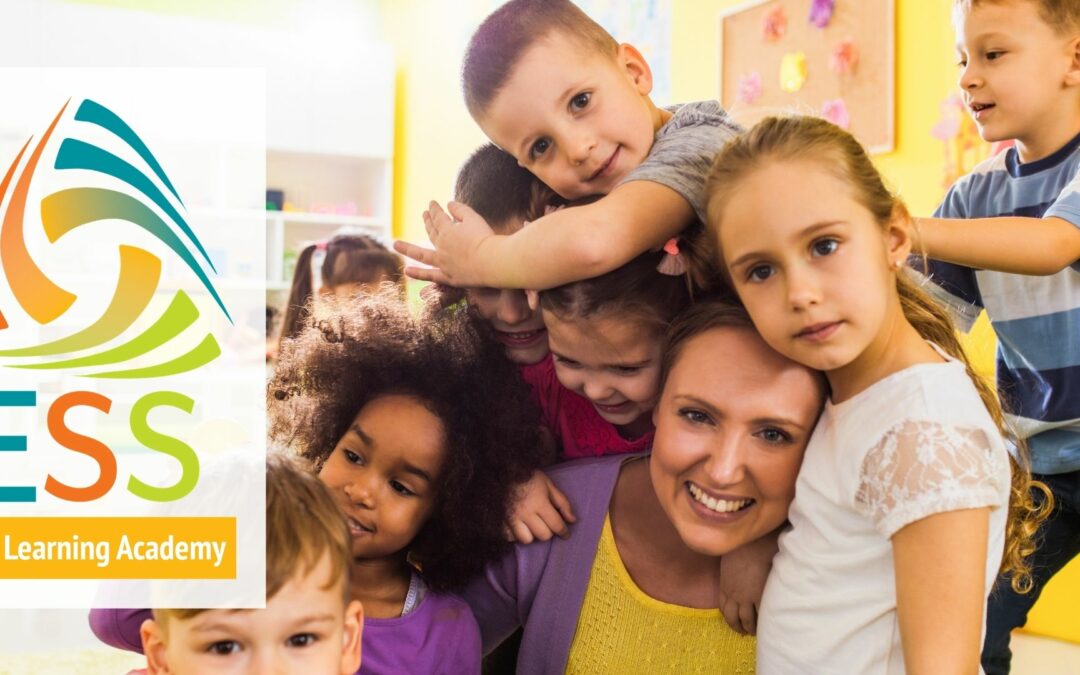
“I think we need to change our view of parents from being ‘extra work for teachers’ to ‘assets to the classroom community’,” said one attendee of last week’s Early Learning Academy, which brought together district teams from around the state to examine their back-to-school transition processes through the lenses of anti-bias and culturally responsive practice.

Another participant added, “Family engagement is not about what information the school can effectively deliver to families. It is about eliminating barriers so that schools can receive authentic information from families,” as a basis for co-constructing the best learning environment for every child.

The session opened with an introduction from Brian Berry, superintendent of Yoncalla School District, and Erin Helgren, the CI site liaison for Yoncalla Early Works, who spoke about the ways anti-bias practices have shaped the work they’ve done even in a rural, mostly white community. Truly, an anti-bias approach creates collaboration and partnership with families that leads to improved outcomes for every student and a stronger community for all, while also addressing systemic inequities head-on.

The session was keynoted by Dr. Tonia Durden and Dr. Iheoma Iruka, two of the authors of the book, Don’t Look Away: Embracing Anti-Bias Classrooms. They shared a wealth of information about the historical and systemic factors that have shaped schools’ interactions with racially and economically marginalized students and families, and highlighted meaningful shifts in classroom and school culture that allow students and parents to engage fully, so that every student is able to reach their potential.


Following the keynote, district teams participated in facilitated planning sessions, working together to apply their learning from the morning to back-to-school transition plans for the coming school year. This work will be ongoing, with districts receiving coaching from the Early School Success (ESS) team throughout the year.


Additional Resources

Professional Development Resource List Developed by Drs. Durden & Iruka

Links to Related Content

Podcast: Anti-Bias Education in Action

Podcast: Anti-Bias Education in Early Childhood

Podcast: Foregrounding Racial Equity in Early Childhood

A Glimpse of How Yoncalla’s Youngest Learners Spend Their Day


ESS Early Learning Academy: School Transitions with an Anti-Bias Lens

ESS Early Learning Academy: School Transitions with an Anti-Bias Lens

As Oregon schools prepare to move into the fall of 2021, the Early School Success team at CI is planning its first ever Early Learning Academy, inviting district teams from around the state to examine educational transitions through an anti-bias lens, with a focus on the love and care that teachers, students, families, and entire school communities need as they continue to move through the challenges associated with the COVID-19 pandemic.

The Academy will begin with a kick-off event on Wednesday, June 23, featuring keynotes from Dr. Iheoma Iruka and Dr. Tonia Durden, two authors of the book Don’t Look Away: Embracing Anti-Bias Classrooms. This event has recently been opened to the public! If you are interested in attending, you can register here by 4pm on Thursday, June 17, 2021.


We’re incredibly honored to welcome our keynote speakers.


Tonia Durden, Ph.D., is a Clinical Associate Professor and Birth-5 Program Coordinator within the Department of Early Childhood and Elementary Education at Georgia State University. Dr. Durden’s primary scholarship and research trajectory focuses on support of African American children’s socio-cultural development. Her goal is to create racially equitable learning experiences for children of color. As a teacher educator and researcher, the focus of her work includes preparing pre-service and in-service teachers to become culturally competent master teachers. Dr. Durden’s professional work and scholarship can be categorized into three core areas of focus: Early Childhood Education (curriculum and program development); racial educational equity (research to professional practice); and Early Childhood Systems Engagement (strategic partnerships and equitable systems building). Dr. Durden is committed to using teacher education and research as an informative vehicle towards helping develop educators and leaders who become culturally responsive change agents and advocates in their classrooms and communities.  


Iheoma U. Iruka, Ph.D., is a Research Professor in the Department of Public Policy, a Fellow at the Frank Porter Graham, Child Development Institute (FPG), and Founding Director of the Equity Research Action Coalition at FPG (the Coalition) at the University of North Carolina at Chapel Hill. Through the Coalition, Dr. Iruka is leading projects and initiatives focused on how evidence-informed policies, systems, and practices in the early years can support the optimal development and experiences of minoritized children and children from low-income households and communities. Her work focuses on ensuring that children start off well, through family engagement and support, quality rating and improvement systems, and early care and education systems and programs. Dr. Iruka focuses on ensuring excellence for young diverse learners, especially Black children and their families, through the intersection of anti-bias, anti-racist, culturally grounded research, program, and policy. Dr. Iruka serves and has served on numerous national and local boards and committees, including the Brady Education Foundation, Trust for Learning, the National Academies of Sciences, Engineering, and Medicine committees, the American Psychological Association’s Board of Educational Affairs, and the Nation Advisory Committee for the U.S. Census Bureau.

She has a B.A. in Psychology from Temple University, an M.A. in Psychology from Boston University, and an M.S. and Ph.D. in applied developmental psychology from the University of Miami, FL. 


Guests are able to register for the June 23 kick-off session. District teams who have committed to a deeper, long-term engagement with the material will receive coaching throughout the 2021-22 school year. 

Children’s Institute would like to thank the Ford Family Foundation and the James F. and Marion L. Miller Foundation for making this event possible.


More From Dr. Iruka and Dr. Durden 

Iheoma Iruka Strives to Make Racial Equity ‘the Air We Breathe’ at FPG

A Shield of Armor

Be Aware: Confronting My -isms

Be Intentional: Culturally Relevant Teaching — My Culture

Be Intentional: Culturally Relevant Teaching — My Beliefs

Be Intentional: Culturally Relevant Teaching — My Teaching

Dear CRT: Creating Culturally Relevant Classroom Environments

Dear CRT: Responsive Interactions

Anti-Bias Education in Action

Anti-Bias Education in Action

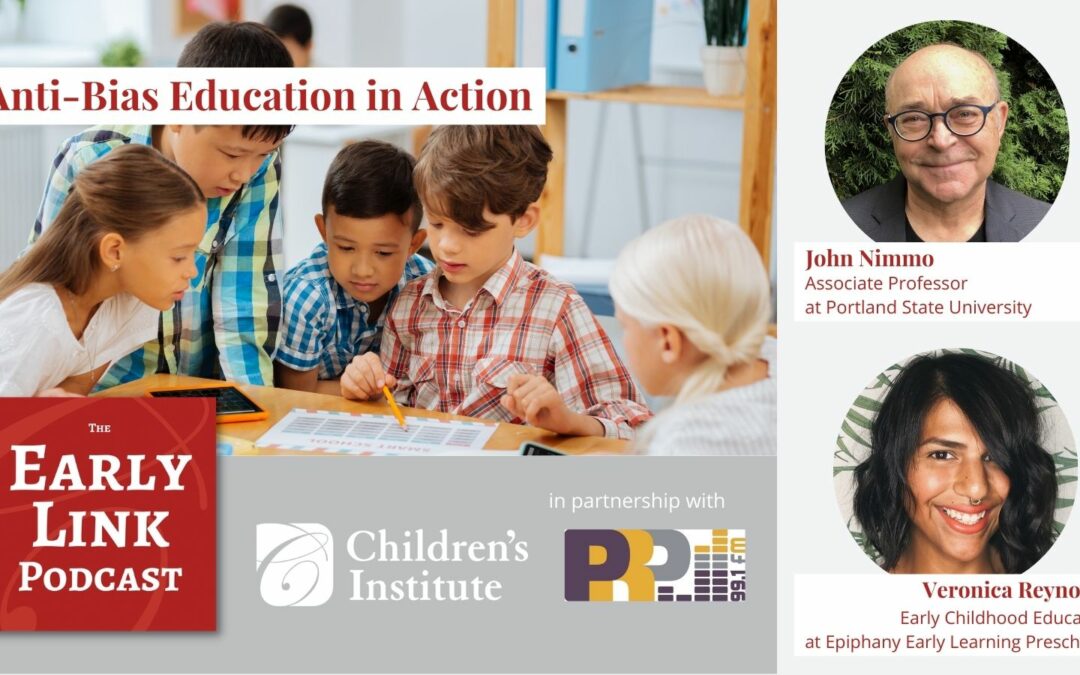
In this episode of The Early Link Podcast, host Rafael Otto speaks with professor John Nimmo about the film he co-produced, Reflecting On Anti-Bias Education in Action: The Early Years. They are joined by one of the teachers featured in the film, Veronica Reynoso, who shares her insight on the value of anti-bias education.

Guests:

John Nimmo, EdD is Associate Professor, Early Childhood Education, in the College of Education at Portland State University. John is a co-producer of an international video documentary on children’s rights and also a 2021 film on anti-bias early education. He holds a doctorate from the University of Massachusetts at Amherst and was previously an early childhood and elementary teacher in his first home of Australia and in the United States.

Veronica Reynoso is an Early Childhood Educator and Mentor Teacher at Epiphany Early Learning Preschool in Seattle, Washington.  Life experience and her experiences at Epiphany Early Learning helped shape her strong commitment to anti-bias and anti-racist education with young children. She is featured in the film, Reflecting On Anti-Bias Education in Action: The Early Years.

Summary:

John talks with Rafael and Veronica about the origins of the film and its intended audience. He also discusses why its important to have anti-bias education for young children even if it means  having hard conversations about disability, race, or gender. Additionally, as one of the teachers in the film, Veronica reflects on her experience, and shares her insight on how to incorporate anti-bias education in the classroom.

Transcript

Rafael Otto: [00:00:06] Welcome to the Early Link Podcast. I’m your host, Rafael Otto. As usual, you can catch us on the airwaves on 99.1 FM and Portland on Sundays at 4:30 PM. Or subscribe and listen, wherever you find your podcasts. Today, I’m speaking with John Nimmo, associate professor of Early Childhood Education at Portland State University, and one of the producers of a new short film called Reflecting on Anti-Bias Education in Action: The Early Years. I’m also speaking with Veronica Reynoso, who is a teacher featured in the film. She currently teaches preschool in Seattle, Washington. Veronica and John, great to have you on the podcast today.

Thanks for joining me.

John Nimmo: [00:00:42] Very excited, Rafael, to be here to share our film.

Veronica Reynoso: [00:00:46] Yeah, excited to share more about anti-bias education. Thanks for having us.

Rafael Otto: [00:00:50] Absolutely. So the film is a… it’s a short piece. It’s a 50-minute film. It just released last week, April 1st. John, my sources tell me that the last anti-biased education film was produced in 1989. Is that right?

John Nimmo: [00:01:05] Yep. Either 1989 or 1988 but about then. Our colleague, Louise Derman-Sparks, who’s pretty well known internationally for the anti-bias education approach, was the creator of that film. And, uh, you know, it was about 30 minutes. You can still find it on the web and it’s sort of indicative of the time of video and sort of the colors getting washed out…

Rafael Otto: [00:01:27] A grainy old video on YouTube somewhere?

John Nimmo: [00:01:29] Uh, yeah, somewhere there, but it had an incredible impact at that time. Really what it was doing was introducing this idea, this approach of anti-bias, (what it was called curriculum then, now education) to the world. It was exactly the same time that they released the first book Anti-Bias Curriculum, which is one of the biggest sellers that NAEYC has.

I think we’re talking about a million copies. They just recently released a… sort of the third version of that book. So it really had the job of introducing this idea to the world and as an alternative to the idea of multiculturalism, which had become a little bit washed out and meaningless as a term at that time.

Rafael Otto: [00:02:09] Talk about the impact from that film. How did it inspire you to make the one that you just released last week?

John Nimmo: [00:02:15] Well, my colleague and I, Debbie LeeKeenan, had been doing a lot of workshops working together over the years. And of course we were constantly asked, “What does this look like in practice?” Because people want to see, not just hear. And she had talked a little bit about wanting another film because we had both used this film, but it was of course getting pretty old and dated. There are maybe one or two other films, again, pretty dated, maybe 20 years or more ago that existed. But otherwise there really wasn’t anything other than the more generic professional development films, which were mostly talking heads – you know, experts talking over images of children – but no real action from the classroom.

So it really came out of a need for teachers to be able to get some sense of what does this really look like in the classroom? So that film had an impact on us of sort of introducing us to the ideas, but really a lot of the scenes in it were, um.. some of them were real and some of them were staged. Again, probably more talking heads than we would have liked because it was more of a training film, but we wanted something that was more provocative and would engage people in conversation rather than the typical, training/professional development film.

Rafael Otto: [00:03:33] Yeah, that’s something that I appreciated about the film. It was…  we’re really seeing what it’s like in the classroom, hearing the kids participate, hearing what it’s like for teachers who are working with children. A very hands-on, practical tool it seems like to me.

Veronica, what was it like to be in the film and participate in the filming process?

Veronica Reynoso: [00:03:52] It was a incredible opportunity to really showcase something that I feel strongly about like, I think everybody should be teaching anti-bias, anti-racist education in their classrooms because these are ideas and theories that children are building from the very beginning, even before they enter my classroom.

So being a part of it was an honor. Especially because I saw the 1989 version in college and I remember sitting in my classroom and even then, which that was 2009, I remember sort of raising my eyebrow and being like, “Hmm. Some of these ideas feel a little outdated right now..” So it was really great to be a part of this project that I had seen in college and to show that this work is continuing, that it’s ever evolving. And I hope that there continues to be more work around it. And that there’s another one in a year, two years, three years because children and each generation that comes, like I tell the children in the classroom everyday, you are teachers too.

You’re teaching me the same way that I am here to teach you. So yeah, it was really exciting to be a part of the project.

For the full transcript, please download the pdf below.


Student Success Act: A Look Ahead to 2020

Student Success Act: A Look Ahead to 2020

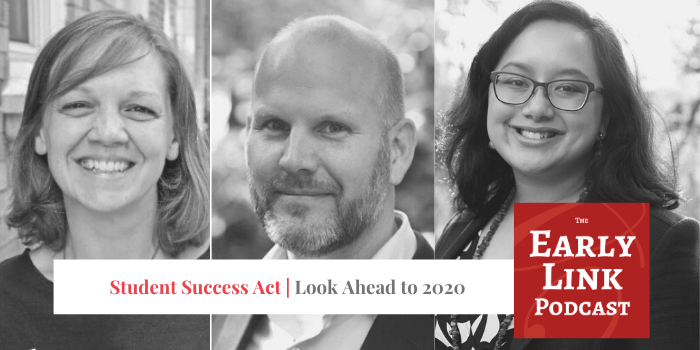
In this week’s episode, we discuss the Student Success Act implementation with Scott Nine from the Oregon Department of Education; Parasa Chanramy, Policy and Implementation Director at Stand for Children; and our own Dana Hepper, Director of Policy and Advocacy at Children’s Institute.

Nine, assistant superintendent at ODE’s Office of Education Innovation and Improvement, leads the stewardship of funds from the Student Investment Account (SIA) under the Student Success Act.

Chanramy shares her thoughts on the SSA in the context of another major funding win for education, passage of Measure 98 in 2016. The measure, championed by Stand for Children, has been credited for helping boost Oregon’s graduation rate to an all time high last year.

Hepper gives listeners a preview of the Early Learning Account’s impact on existing programs and program expansion.