
With Gratitude to our Champions for Children

With Gratitude to our Champions for Children

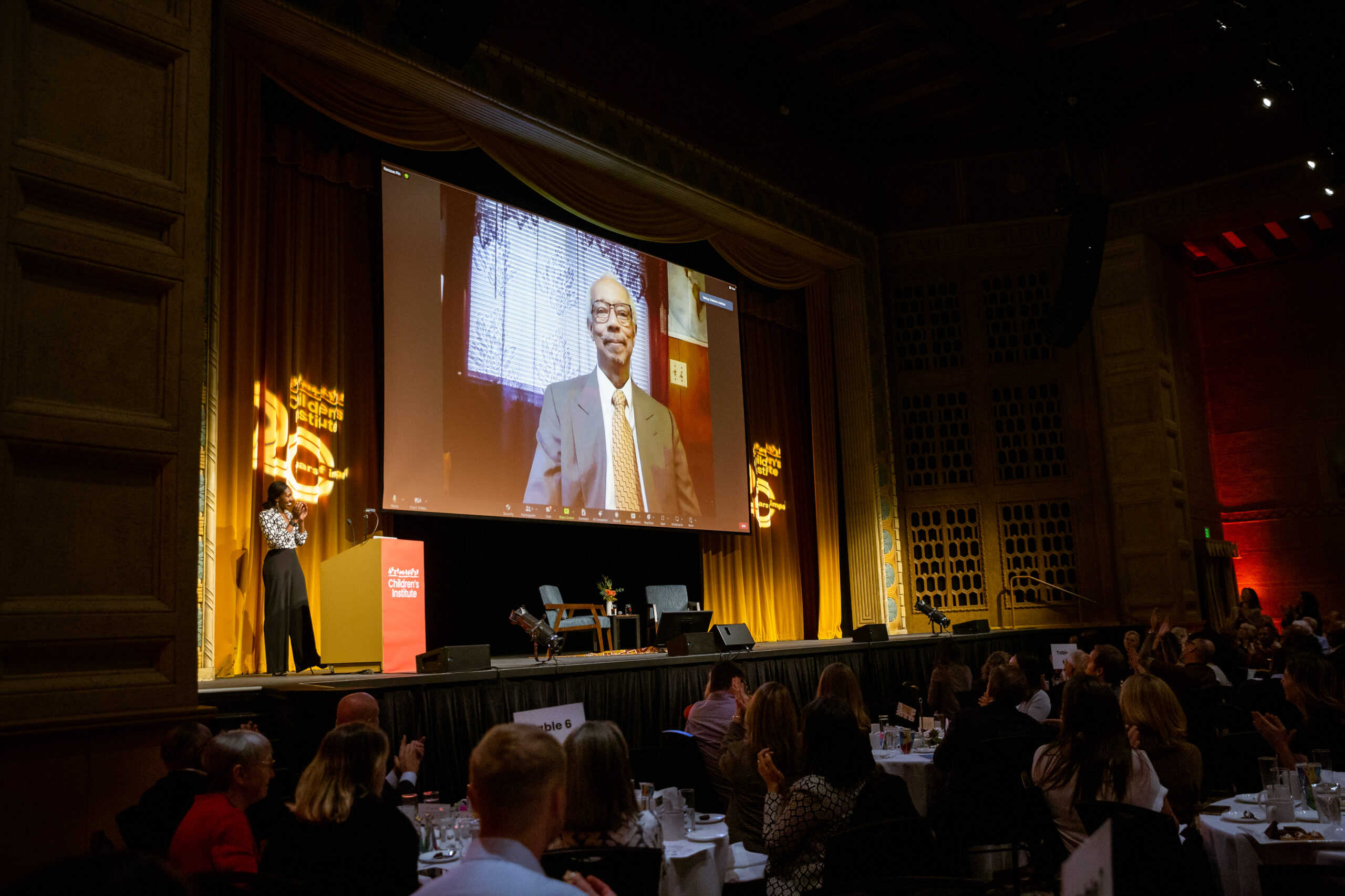
It is with profound joy and gratitude that I reflect on our recent Champions for Children – 20 Years of Impact event, celebrating the past two decades of Children’s Institute’s work to make Oregon the best place to be a kid.  

Among the 550 plus champions who filled the room, including our friends who joined virtually from Central and Eastern Oregon (and a few from out-of-state!), I was in awe of the power of our collective community and it truly took my breath away.  

But building a society that honors and supports children from the moment they are born takes more than one event or any singular act. It requires a daily commitment and a choice to be better, to do better.  

It takes a concentrated effort to ensure all children have access to early literacy programs, a seamless educational experience, maternal-infant health support, and safe, nurturing child care facilities.  

Race, geography, language, and income level should never be a barrier to that. This is what justice for children means.  

The event was a testament to the movement itself, and an unwavering dedication of many people across sectors that include educators, early childhood providers, community leaders, business leaders, policymakers, and philanthropic champions–all committed to ensuring a brighter future for our children. It builds on a legacy of two decades of work and leans into the possibility of what tomorrow holds.  

Click through for event photos!


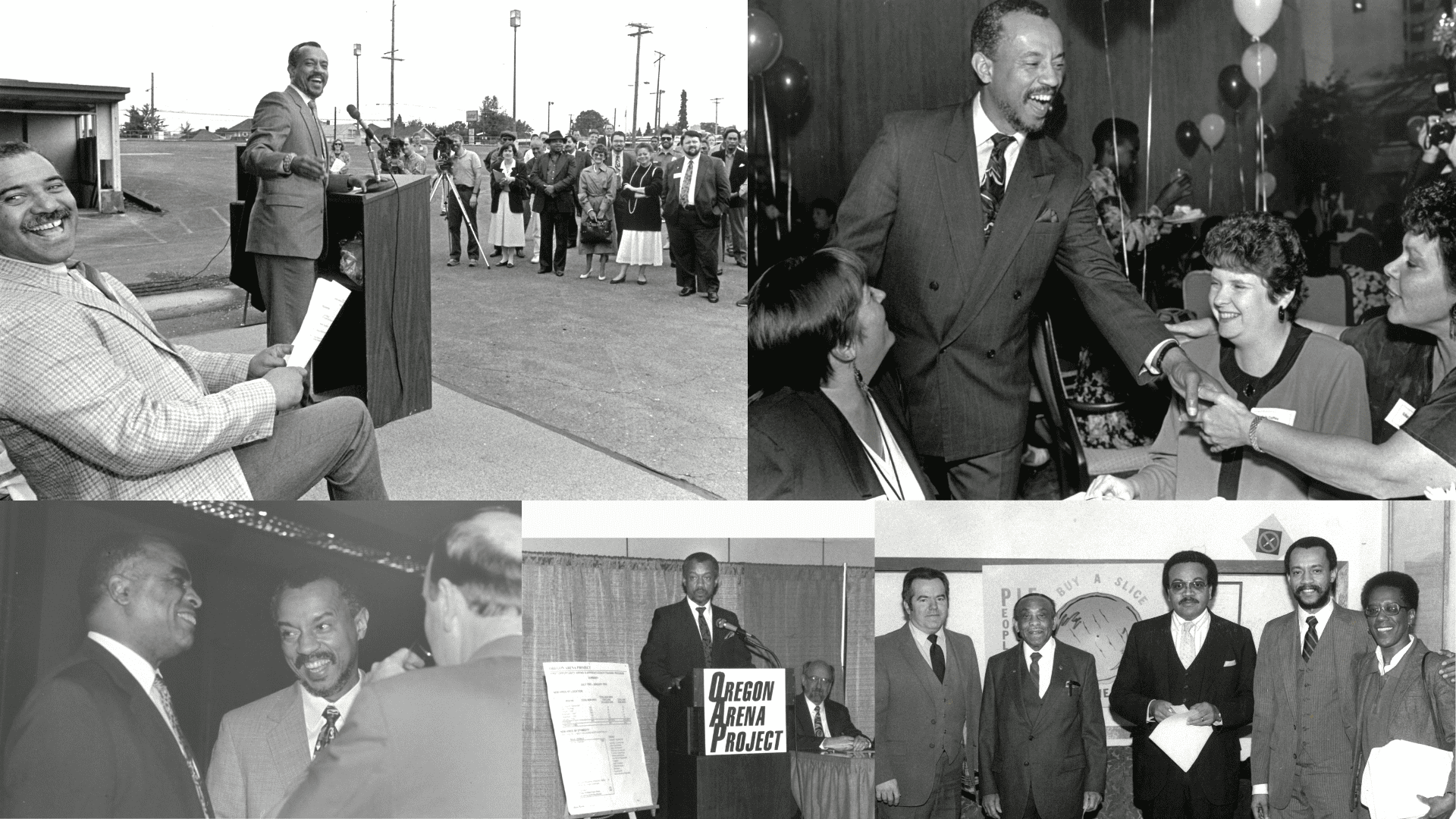
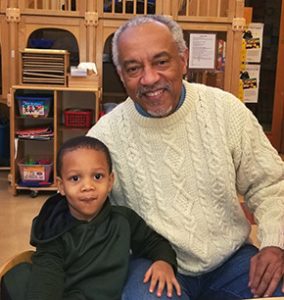
We had the honor of presenting the legendary Ron Herndon with the 2023 Alexander Award for his exemplary leadership and advocacy for our youngest learners both locally and nationally, and his civil rights leadership for Black and brown communities in Portland for more than 50 years.  

If Ronnie isn’t an inspiration, I don’t know who is. I hope we can all aspire to do what he has done, and lean into the work purposely and unwaveringly, to show up as THE BEST, true champions, for children.  

I invite you to join us in this exciting journey ahead. The impact of our collective efforts is immeasurable, and I am confident that the future holds even greater promise. 

Join us in making Oregon the best place to be a kid.

If you missed the event and want to give, you can still make a donation or volunteer to help ensure that Children’s Institute continues to impact Oregon’s young children for the next 20 years and beyond.
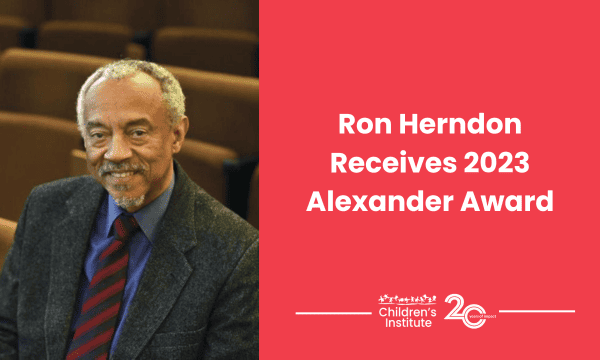
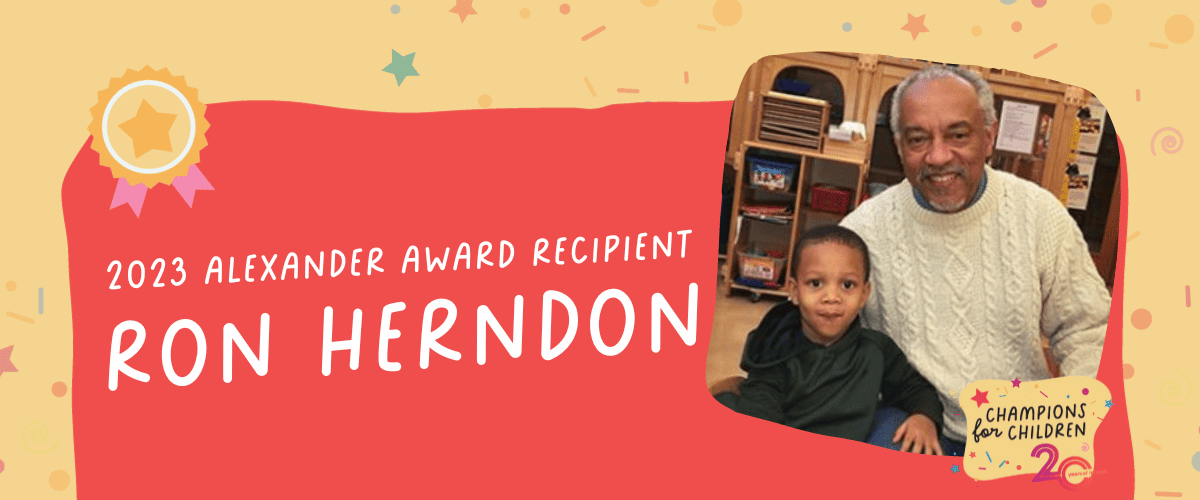
Early Childhood Champion Ron Herndon Honored with the 2023 Alexander Award

Early Childhood Champion Ron Herndon Honored with the 2023 Alexander Award

In the heart of Portland, there is an exceptional individual who has spent a lifetime dedicated to turning hopes and aspirations into concrete actions, and who exemplifies what it means to be a champion for children.

We had the honor of presenting Ron Herndon with the 2023 Alexander Award at Children’s Institute’s Champions for Children – 20 years of Impact event on October 19.

Ron transcends the role of a community leader; he is a living testament to the power of commitment, advocacy, and unwavering dedication to the well-being of our children and families here in Oregon, and across the nation. Ron’s focus on institutional and systemic change promises a brighter future for all children, where the playing field is truly equitable.

“Ron Herndon has led transformative change in Oregon for decades with vision, innovation, and a deep commitment to  ensure all children, birth to grade 5, and their families have what they need to thrive,” said  Kali Thorne Ladd, Children’s Institute’s chief executive officer. “We are all better because of him.

In 1975, Ron took the helm as the Director of Albina Head Start. It was there that he laid the foundation for a legacy that would expand far beyond the walls of early learning centers. From 1991 to 2013, his journey took a national stage as he assumed the roles of President and Board Chair of the National Head Start Association (NHSA). This position was a platform for transformative change and pivotal in elevating the quality of Head Start programs nationwide. As Chair, he provided unyielding leadership and support, including advocating for over 900,000 children and families. Ron’s dedication and leadership in this role transformed early childhood education across the nation, ensuring that children with the least access to early learning opportunities received a solid foundation for success.

Ron’s contributions have earned him high regard, deep respect, and fond admiration from a vast community of friends and admirers whom he continues to inspire.

Joe McFerrin, chief executive officer at Portland Opportunities Industrialization Center (POIC), aptly notes, “Ronnie Herndon’s leadership and impact in the field of early childhood development are incredible, but his positive influence on professionals working with children of all ages is immeasurable.”

Ralph Smith, managing director at the Campaign for Grade-Level Reading vividly recalled Ron’s impact, describing him as a “one-of-kind visionary leader, courageous advocate, and tireless warrior for social justice and economic uplift.”

Beyond his leadership roles, Ron’s influence through mentorship has also created a ripple effect.

“Ronnie is a true visionary,” said Miriam Calderon, chief policy officer at ZERO TO THREE. “There are few leaders who have stood for centering racial and social justice in early childhood as he has. I feel blessed to have him as a mentor since early in my career and know that I am not alone, as he has so generously done that for many in this field, and that is part of his legacy and impact.”

It is not just about mentorship, but also about driving lasting change. Governor Tina Kotek underscored this point when she shared how Ron has left an indelible mark on generations of Oregonians.

“For more than 50 years, Ron Herndon has been a powerful voice for the Black community in Portland, especially for the needs of children in North and Northeast Portland,” she said. “As a community leader, he has supported essential services for generations of Oregonians – perhaps most importantly through the growth of Albina Head Start – guiding it from an organization that served more than 100 kids to well over 1,000.”

As we honor Ron Herndon with the 2023 Alexander Award, we celebrate not just a community leader, but a beacon of hope.

In the words of Tony Hopson, “Many people hope for change, some people talk about change, but few people make change. Ronnie represents the few.”

We express our heartfelt gratitude to Ron, his legacy and relentless dedication, and unwavering commitment to create a brighter future for all children.

More about the Alexander Award 

The Alexander Award is named for prominent Oregon leader Dick Alexander and was first awarded by Children’s Institute to Governor John Kitzhaber in 2013 for his work building Oregon’s early childhood system. Since then, the award has recognized individual leaders such as Ken Thrasher and Sue Miller and communities like Wallowa County for significant work to improve the lives of young children. Beyond honoring individual leaders and communities, the Alexander Award calls attention to the need for business and civic leaders to work together to build a system of programs and services to support children’s healthy development and school readiness in order to ensure Oregon’s future success. 

Related Links:

Oregon Legislature Announces Members of a Child Care Task Force

Oregon Legislature Announces Members of a Child Care Task Force

Children’s Institute President & CEO Swati Adarkar will serve on a legislative task force charged with evaluating Oregon’s current child care system and proposing solutions that will ensure all families have access to stable, quality child care that meets their needs by 2025. The Joint Task Force on Access to Quality Affordable Child Care, formed following last year’s passage of HB 2346, includes state lawmakers, early care and education providers, early childhood and family advocates, business leaders, and parents.

  • Senator Tim Knopp
  • Senator Kathleen Taylor
  • Representative Cedric Hayden
  • Representative Karin Power
  • Swati Adarkar, President & CEO, Children’s Institute
  • Miriam Calderon, Early Learning System Director, Early Learning Division
  • Brenda Comini, Early Learning Hub Director, Better Together Central Oregon
  • Josie Emmrich, Owner & Lead Teacher, Loving Beginnings Preschool and Child Care
  • Regan Gray, Child Care Policy Advisor, Family Forward
  • Dan Haun, Self-Sufficiency Program Director, Oregon Dept. of Human Services
  • Ron Herndon, Director, Albina Head Start
  • Natalie Jackson, Child Care Director, SEIU503
  • Jenny Lee, Advocacy Director, APANO
  • Yolanda Morales, Parent, Eastern Oregon Child Care Resource & Referral
  • Marie Simonds, Program Manager, Wild Rivers Coast Alliance
  • Elanna Yalow, Chief Academic Officer, KinderCare

The child care task force was approved last year in response to Oregon’s growing child care crisis: the entire state has been designated a child care desert for kids ages 0–2 and the median price of full-time care for an infant is more than a year of public college tuition.

HB 2346 also directs Oregon’s Early Learning Division to examine our child care system. The ELD recently released the first of three reports, “The State of Early Care & Education and Child Care Assistance in Oregon.”


Black Student Achievement in Portland: A Conversation with Kali Ladd and Ron Herndon

Black Student Achievement in Portland: A Conversation with Kali Ladd and Ron Herndon


In this segment, we speak with Kali Ladd and Ron Herndon. Kali is executive director and co-founder of KairosPDX, a nonprofit organization that houses a public charter school in North Portland. As an organization, Kairos is dedicated to closing opportunity and achievement gaps for historically marginalized children. Ron is the long-standing director of Portland’s Albina Head Start with a background in activism and leadership advocating on behalf of low-income families and children.

We discuss the public charter school at Kairos, which is currently housed in a building owned by Portland Public Schools (formerly Humboldt Elementary School) and has been at risk of losing its lease with the district. At the center of the story is black student achievement and the historic experiences of black children in the district and in Oregon.

Today, Portland Public Schools has the largest number of black students enrolled in Oregon—nearly 4,500 children—accounting for nearly 10 percent of the district’s student body. For the top 10 districts in Oregon enrolling black students, nine of which are in the Portland metro area, black student achievement in English Language Arts and Math falls well below state targets. Additionally, achievement gaps between black and white students are significant and persistent from third to eleventh grade. In Portland Public Schools, for example, 22 percent of black students meet benchmarks in English Language Arts in grades three to five compared with 73 percent of white students. This is the largest black-white achievement gap in English Language Arts among the top 10 districts enrolling black children.

At the root of the problem, Herndon says, “I think not only in Portland Public Schools but certainly throughout the country, there’s this perception that black children come in to the system as damaged goods, that they come from families that are filled with deficits and there is the expectation that they won’t do as well. And unfortunately, frequently, children will meet our expectations.”

The Black Students in Oregon report, originally commissioned by Black Parent Initiative in 2009, was updated and released in 2017 based on a request by KairosPDX. The updated report uses 2015–2016 data and documents persistence disparities and achievement gaps for black children. The report says that “the goal of closing the achievement gap continues to elude Oregon schools.”

Ladd, with her Reggio Emilia-inspired approach to elementary education, says the value of a program like Kairos for Portland Public Schools and Portland’s black community is tangible. “We’re having an impact and our data shows we’re getting results. Black students as an aggregate are the lowest performing students right now in Portland Public Schools. If we can improve outcomes for those students, many other students will benefit. I definitely feel like there are elements of the model that can be replicated regardless of the cultural makeup of the student body. It’s important to be culturally specific whatever the culture group is your working with, because that’s part of the identity and sense of self.”

An Interview with Ron Herndon

An Interview with Ron Herndon

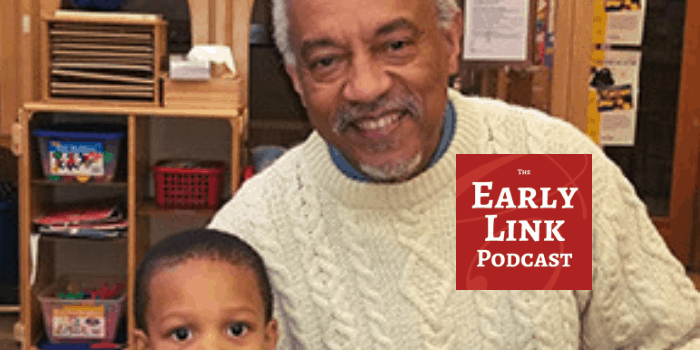
We invite you to spend an hour listening to our interview with Ron Herndon, a long-time community leader and activist in Portland and nationally. He has been the director of the Portland-based Albina Head Start since 1975, and his background includes more than four decades of advocacy efforts on behalf of low-income families and young children, and Portland’s black community.
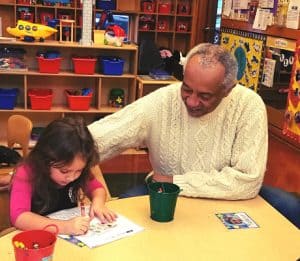
Having served as chairman of the board for the National Head Start Association for 20 years, from 1993 to 2013, Herndon offers a unique historical perspective on early childhood in Portland and nationally. Today, his Head Start and Early Head Start programs serve more than 1,000 children in 33 classrooms at 25 locations in North, Northeast, and Southeast Portland. And he has recently pioneered a Mandarin language program, the first of its kind for a Head Start program in the US.

In this interview, we discuss the history of Albina Head Start, racial discrimination and segregation in Portland, and the history of state and federal policy that systematically isolated and suppressed Portland’s African-American community — actions that still have lasting impact today. Herndon also provides his commentary on the history of education in the country, what is lacking for low-income children, the importance of teacher training and family empowerment, and ideas for changing the lives of children with a commitment to their well-being and success.

Please tune in, share, and enjoy.

Interview Highlights

[1:05] The origins of Albina Head Start and Ron’s recruitment by Head Start parents.

[3:03] History of the Albina neighborhood in Portland.

[5:37] Disruption of the black community in Portland and the origins of redlining and housing discrimination.

[9:30] Gentrification versus discriminatory policies such as redlining.

[12:09] Displacement of black people from the Albina neighborhood alongside displacement of black children from black schools.

[18:45] Herndon’s role in the Black United Front to end school bussing policies in the 70s and 80s.

[24:22] Comparing school bussing policies from the 70s to voucher policies in effect today.

[31:14] The reading instruction controversy in Head Start.

[36:29] On the lack of diversity in early learning leadership.

[39:41] The innovation of the Center Training Assistant (CTA) program.

[44:44] Comments on what it takes to run a “high-quality” program and the importance of parent involvment.

[47:36] The future of Head Start and Early Head Start.

[58:04] “Children can learn what we are prepared to teach them. If we set goals and have high aspirations for children the majority of the time they will reach them.”

[1:01:44] Advice on engaging in activism today and pushing for institutional change.