
With Gratitude to our Champions for Children

With Gratitude to our Champions for Children

It is with profound joy and gratitude that I reflect on our recent Champions for Children – 20 Years of Impact event, celebrating the past two decades of Children’s Institute’s work to make Oregon the best place to be a kid.  

Among the 550 plus champions who filled the room, including our friends who joined virtually from Central and Eastern Oregon (and a few from out-of-state!), I was in awe of the power of our collective community and it truly took my breath away.  

But building a society that honors and supports children from the moment they are born takes more than one event or any singular act. It requires a daily commitment and a choice to be better, to do better.  

It takes a concentrated effort to ensure all children have access to early literacy programs, a seamless educational experience, maternal-infant health support, and safe, nurturing child care facilities.  

Race, geography, language, and income level should never be a barrier to that. This is what justice for children means.  

The event was a testament to the movement itself, and an unwavering dedication of many people across sectors that include educators, early childhood providers, community leaders, business leaders, policymakers, and philanthropic champions–all committed to ensuring a brighter future for our children. It builds on a legacy of two decades of work and leans into the possibility of what tomorrow holds.  

Click through for event photos!


We had the honor of presenting the legendary Ron Herndon with the 2023 Alexander Award for his exemplary leadership and advocacy for our youngest learners both locally and nationally, and his civil rights leadership for Black and brown communities in Portland for more than 50 years.  

If Ronnie isn’t an inspiration, I don’t know who is. I hope we can all aspire to do what he has done, and lean into the work purposely and unwaveringly, to show up as THE BEST, true champions, for children.  

I invite you to join us in this exciting journey ahead. The impact of our collective efforts is immeasurable, and I am confident that the future holds even greater promise. 

Join us in making Oregon the best place to be a kid.

If you missed the event and want to give, you can still make a donation or volunteer to help ensure that Children’s Institute continues to impact Oregon’s young children for the next 20 years and beyond.
Home Visits Help Families Stick Together

Home Visits Help Families Stick Together

Early Childhood advocates, providers, and parents brought their voices together in 2022 to tell decision makers that investing in family support programs is vital to kids and families, and an important piece of the early childhood system.

This year, we saw big policy wins for family support programs, including wage increases for and restoring service in Healthy Families Oregon and relief nurseries. During the 2022 session, The Oregon legislature passed House Bill 4005 and the Child Care Emergency Response Package, an historic $100 million investment in Oregon’s early childhood system. 

Now that the session has ended, we’re joyful about the investments that will support the recruitment and retention of early childhood providers in both of these programs, which will ensure that there are enough people to serve families, and that providers are making a living wage. Stabilizing a skilled, diverse workforce is a critical component in improving services and ultimately, ensuring that kids and families have access to support when they need it.

We talked to parents who have participated or are currently participating in voluntary home visiting, offered through both Healthy Families and relief nurseries, and they emphasized why continued investment in family support programs is so needed.

Marnesha Strickland learned about voluntary home visiting services for parents with newborns in the hospital, after she gave birth to her daughter. Shortly thereafter, she met with a home visitor through Albina Head Start, a contractor providing Healthy Families Oregon Services.

Kalisha Griffin is another parent who participates in home visiting services through Albina. She said that her doctor referred her to the program and that her home visitor has helped her connect to resources she may not have discovered otherwise.

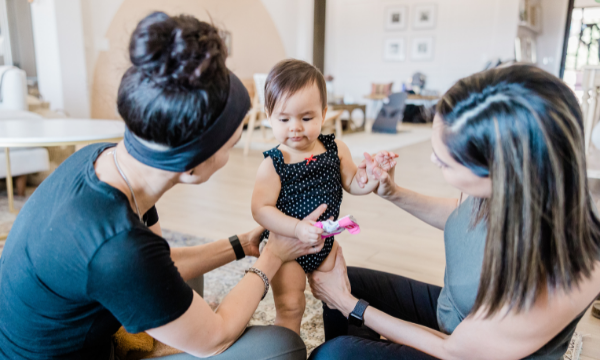
Home visits are free and voluntary, and are designed to improve health outcomes for children and parents, encourage positive child development, and enhance family well-being. Home visits focus on the whole family, including helping parents meet their own goals. 

Natasha Griffin has a one-year-old, and meets virtually with her home visitor once a week. Griffin shared that  home visiting services have helped her to pursue a job in early education, and she recently took a position as a teacher’s assistant with Albina Head Start. 

Home visiting services aren’t just for first-time parents. Constance Arron explained that she reconnected with her home visitor when she had a baby eight years after having her last child, and that having the support of a home visitor brought comfort as she navigated parenting a new baby.


The Child Care Emergency Response Package and House Bill 4005 are steps towards progress, but are a short-term solution to address the immediate child care crisis, which has been exacerbated by the COVID-19 pandemic. Together these bills will:

  • Provide $2 million to Healthy Families Oregon and relief nurseries to raise wages
  • Fund an additional $122,830 to restore Healthy Families Oregon services
  • Increase the amount of money providers who accept Employment Related Day Care (ERDC) subsidies receive per child, bringing rates to a more equitable level
  • Provide $21 million in direct relief payments of $500 each to currently-working child care providers—one payment in 2022 and another in 2023
  • Invest $39.3 million to recruit and train new child care providers, and provide direct grants to expand existing facilities of all types
  • Direct $3.6 million to the Department of Early Learning & Care

There is still work to be done to make significant, long-term progress within the early childhood system. In 2023, Children’s Institute and the Early Childhood Coalition will continue to advocate for lasting solutions that will expand access to early childhood programs, child care, and family support services.

We want to give a heartfelt thank you to the parents who shared their experiences with us.


Related Links

‘You feel like you have someone in your corner,’ Parents and Providers Urge Leaders to Invest in Family Support Programs, Home Visiting Services

Funding Relief Nurseries is an Investment in Families and Communities

Oregon’s Early Childhood Coalition Releases 2021 Legislative Report

Early Education is Infrastructure for Oregon’s Workforce

Early Education is Infrastructure for Oregon’s Workforce

The COVID-19 pandemic, and the resulting increase in telecommuting and distance learning for children has elevated the importance of early learning and care as a key component supporting Oregon’s workforce. Many parents who lost jobs at the beginning of the pandemic were unable to return to work because they needed to stay home to be with their small children, who were unable to return to preschool and child care or were attending school online. This dynamic highlighted that child care and preschool are essential elements of the infrastructure necessary for our economy to function.

And yet, early childhood education is hard to come by for all, and extremely expensive for families that don’t qualify for government sponsored programs. According to an Oregon State University report, 72 percent of Oregon communities are child care deserts. These child care deserts are places where less than a third of children aged 0 – 5 have access to regulated early education facilities. And statewide averages of care costs for preschool age children range from $700 – $1200/month, with even higher prices to care for infants and toddlers.

The lack of early education facilities and the high cost of care is felt by families across the economic spectrum, but the COVID-19 pandemic shows how these factors disproportionately affect low-income families. A Pew Research Center report revealed that 76 percent of lower income workers could not work at home, compared to 44 percent of upper income workers. Those parents who kept their jobs by immediately going virtual were tasked with caring for their children and simultaneously juggling work responsibilities while at home. But workers in jobs that cannot be done from home were either laid off or left jobs in order to stay home with their children, or pieced together child care.

We interviewed child care providers and they underscored the significance of early learning programs for the economy.  


The Business Case

Lauren Sigman, early learning coordinator for the Lincoln County School District said, “We need businesses, local governments, and the state to collaborate to increase capacity with the recognition that child care is necessary infrastructure for employees to go to work.” Maria Weer, executive director at Building Healthy Families in Enterprise, Oregon points out that this is now contributing to staff shortages at all types of businesses. She said that “the business community is stating clearly that they can’t recruit staff because people don’t have child care. The hospital was having so much trouble recruiting staff without providing child care that they bought a modular home and put it in their parking lot to create that.”

In Oregon’s mixed delivery system, all types of child care and preschool programs offer important and distinct qualities that help families and the economy thrive.

Home-based Providers

Small scale child care and preschools located in residences fill an important niche in the delivery system. Zakkiyya Ibrahim, director at Education Explorers in Washington County said, “a lot of families are saying they need evening and weekend care, or early morning care and most commercial centers cater to 9:00 a.m. to 5:00 p.m. workers. Home-based child care programs are the ones that cater to families that have odd hours and work weekends.” This is an equity issue. For parents working non-traditional work hours, racist and structural barriers to employment, education, and access to services make child care access even more difficult. In Oregon, nearly one-third (31 percent) of young children in working families have parents working non-traditional hours.

Community-Based Organization Centers (CBO’s)

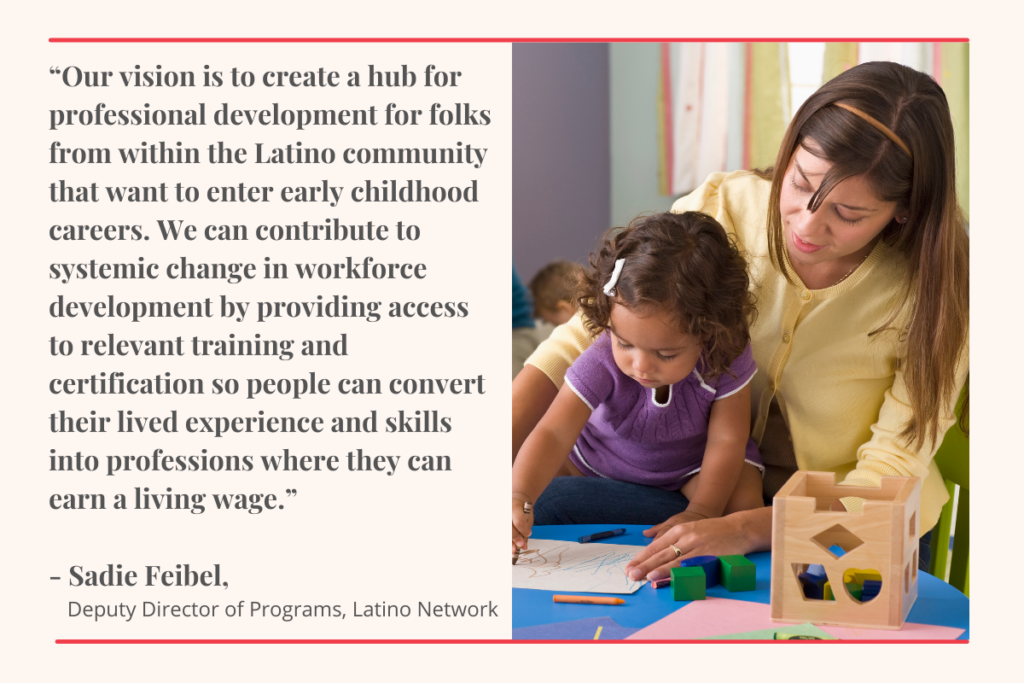
Early education programs run by non-profit organizations are uniquely positioned to provide particular benefits to families and businesses. They can access a wide range of funding and can leverage culturally relevant services of their organizations to provide wrap-around family support, like helping teach parents new skills and help them find jobs. Sadie Feibel, deputy director of programs at the Latino Network in Multnomah County stated that job training will be included in the new site they are building, which will include a preschool. “Our vision is to create a hub for professional development for folks from within the Latino community that want to enter early childhood careers,” she said. “We can contribute to systemic change in workforce development by providing access to relevant training and certification so people can convert their lived experience and skills into professions where they can earn a living wage.”

Onsite Care at Schools, Housing, and Workplaces

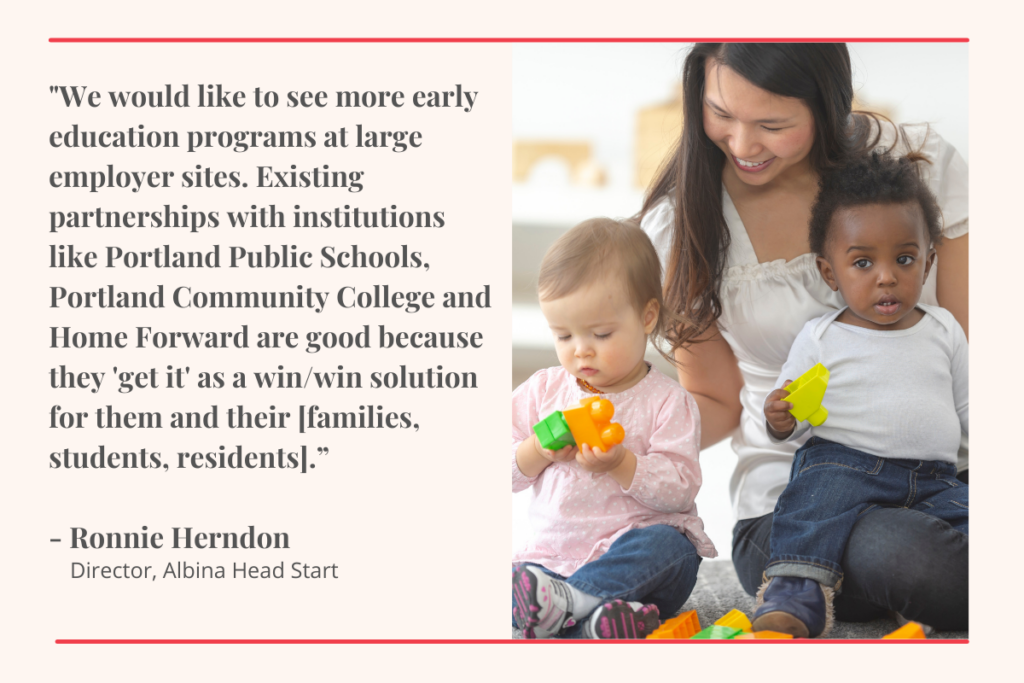
Preschools and child care providers located in schools, within or adjacent to affordable housing, and accessible to employees at their workplaces can help parents stay employed, particularly by easing transportation challenges for families. School-based programs allow parents to consolidate their transportation when older siblings are students in the school where their younger children are preparing for a seamless transition to kindergarten. Programs co-located with affordable housing and at workplaces remove the extra transportation altogether. Ronnie Herndon, director of Albina Head Start in Multnomah County said, “we would like to see more early education programs at large employer sites. Existing partnerships with institutions like Portland Public Schools, Portland Community College and Home Forward are good because they “get it” as a win/win solution for them and their people (families, students, residents).”

‘You feel like you have someone in your corner,’ Parents and Providers Urge Leaders to Invest in Family Support Programs, Home Visiting Services

‘You feel like you have someone in your corner,’ Parents and Providers Urge Leaders to Invest in Family Support Programs, Home Visiting Services

When Marnesha Strickland gave birth to her daughter, the hospital connected her with a program to support her with her newborn. Shortly thereafter, Strickland was introduced to Vanessa Stewart, a home visitor with Albina Head Start, which is a contractor providing Healthy Families Oregon (HFO) services, including home visits.

Home visits are free, voluntary, and offer support and education to people who are pregnant or parenting newborns. These services are offered in communities across Oregon and are designed to improve health outcomes for children and parents, encourage positive child development, and enhance family well-being. Before the pandemic, visits occurred weekly in families’ homes; now, home visitors and parents meet virtually. Families can choose to participate for six months or longer, depending on their needs, and visits can continue for up to three years. 

Vanessa Stewart has been a home visitor for 23 years and is passionate about working alongside families as they navigate parenthood. “I love my job,” she said. “I love to help my families with child development activities, set goals, and help them find and access resources.”

“A lot of families aren’t able to get into the classroom, but they still get support with home visits and they can still teach their kids, and have someone to help guide them.”

Stewart worked with Strickland and her young daughter for three years. Today, Strickland’s daughter is over the age of three, and although she no longer uses home visiting services, she said that visits with Stewart provided her with extra support, parenting tips, learning techniques to teach her young daughter, and someone to talk to.

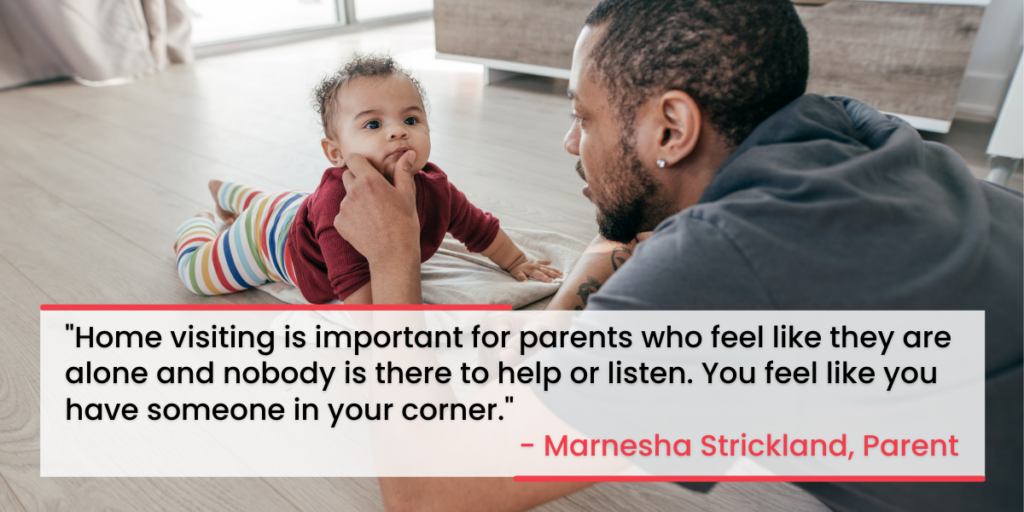
“Home visiting is important for parents who feel like they are alone and nobody is there to help or listen,” said Strickland. “You feel like you have someone in your corner. Miss Vanessa was not just my caseworker — she went above and beyond to help me and my daughter.”

Unfortunately, the early childhood sector — and specifically, family support programs like Healthy Families Oregon and relief nurseries — faces workforce and recruitment shortages, putting these vital early childhood and family services at risk. 

Family support programs are effective because they build deep relationships with parents and children, and support the self-determination of families. That means stabilizing a skilled, diverse workforce is a critical component in improving services, and Oregon’s early childhood providers should not have to live in poverty.

Currently, Healthy Families Oregon and Oregon Relief Nurseries provide services to 2,300 families and 3,500 children, respectively, but have not been able to raise wages to match other early childhood programs, such as Preschool Promise and Oregon Head Start PreKindergarten, let alone wages in other sectors with similar skills. 

Kara Tachikawa, Executive Director of Mountainstar Relief Nursery, explained that with the current super-competitive hiring market and increasing cost of living, relief nurseries are not able to offer the salaries necessary to attract highly qualified staff.

“Many of our organizations are only able to offer the same, and sometimes even less than local fast food or grocery store entry-level positions,” said Tachikawa. “This makes it less likely that people with education and experience in social work or infant mental health will join the statewide team of relief nurseries, where their skills are desperately needed in order to keep children safe with their families and help parents become the best they can be.”

If legislators want to interrupt the negative cycle of trauma and decrease future state costs related to foster care, special education, criminal justice, and long-term negative health outcomes, they should make an investment now.

In the 2021 legislative session, Oregon’s Early Childhood Coalition asked for $4.8 million for relief nurseries and $10 million for Healthy Families Oregon, largely to raise wages. However, relief nurseries received only $2 million of their wages request, and HFO received $800,000 — not to raise wages, but to serve more families.

This year, Oregon’s Early Childhood Coalition is supporting investments that were incomplete in 2021:

  • $2.8 million investment in Relief Nurseries to achieve wage parity with other early childhood programs to reduce turnover and improve consistency
  • $3.746 million investment in Healthy Families Oregon to raise wages to be comparable with other early childhood programs to support retention and recruitment of staff
  • $275,000 investment to continue Healthy Families Oregon services in Tillamook and Jefferson counties, which have lost the Federal Maternal Infant Early Childhood Home Visiting (MIECHV) funding. The full biennial cost to restore funding is $245,660 in Tillamook and $130,000 in Jefferson.

“If legislators want to interrupt the negative cycle of trauma and decrease future state costs related to foster care, special education, criminal justice, and long-term negative health outcomes, they should make an investment now,” said Tachikawa. 

Black Student Achievement in Portland: A Conversation with Kali Ladd and Ron Herndon

Black Student Achievement in Portland: A Conversation with Kali Ladd and Ron Herndon


In this segment, we speak with Kali Ladd and Ron Herndon. Kali is executive director and co-founder of KairosPDX, a nonprofit organization that houses a public charter school in North Portland. As an organization, Kairos is dedicated to closing opportunity and achievement gaps for historically marginalized children. Ron is the long-standing director of Portland’s Albina Head Start with a background in activism and leadership advocating on behalf of low-income families and children.

We discuss the public charter school at Kairos, which is currently housed in a building owned by Portland Public Schools (formerly Humboldt Elementary School) and has been at risk of losing its lease with the district. At the center of the story is black student achievement and the historic experiences of black children in the district and in Oregon.

Today, Portland Public Schools has the largest number of black students enrolled in Oregon—nearly 4,500 children—accounting for nearly 10 percent of the district’s student body. For the top 10 districts in Oregon enrolling black students, nine of which are in the Portland metro area, black student achievement in English Language Arts and Math falls well below state targets. Additionally, achievement gaps between black and white students are significant and persistent from third to eleventh grade. In Portland Public Schools, for example, 22 percent of black students meet benchmarks in English Language Arts in grades three to five compared with 73 percent of white students. This is the largest black-white achievement gap in English Language Arts among the top 10 districts enrolling black children.

At the root of the problem, Herndon says, “I think not only in Portland Public Schools but certainly throughout the country, there’s this perception that black children come in to the system as damaged goods, that they come from families that are filled with deficits and there is the expectation that they won’t do as well. And unfortunately, frequently, children will meet our expectations.”

The Black Students in Oregon report, originally commissioned by Black Parent Initiative in 2009, was updated and released in 2017 based on a request by KairosPDX. The updated report uses 2015–2016 data and documents persistence disparities and achievement gaps for black children. The report says that “the goal of closing the achievement gap continues to elude Oregon schools.”

Ladd, with her Reggio Emilia-inspired approach to elementary education, says the value of a program like Kairos for Portland Public Schools and Portland’s black community is tangible. “We’re having an impact and our data shows we’re getting results. Black students as an aggregate are the lowest performing students right now in Portland Public Schools. If we can improve outcomes for those students, many other students will benefit. I definitely feel like there are elements of the model that can be replicated regardless of the cultural makeup of the student body. It’s important to be culturally specific whatever the culture group is your working with, because that’s part of the identity and sense of self.”