Pay For Early Childhood Educators and Childcare Providers

Pay For Early Childhood Educators and Childcare Providers

Pay For Early Childhood Educators and Childcare Providers
How do we recognize preschool teachers and childcare providers for the important work they do without further raising the cost of high-quality childcare and preschool? We want to hear what you think! Join us and the Oregon Head Start Association for a Twitter chat on the topic. For background information on the topic, check out these recent stories that highlight the issues at stake:

The New York Times: Why Are Our Most Important Teachers Paid the Least?

This article showcases the demanding work done by preschool teachers, and the low pay they receive for such work. The article also discusses the body of research that shows that high-quality preschool can be effective at closing opportunity gaps for low-income children and children of color.

The Washington Post: Will a College Degree Requirement Lead to Better, More Respected Preschool Teachers?

This article highlights the challenges facing preschool teachers, including high demand for early childhood programs, high staffing requirements and corresponding high costs, and limited government support to help families pay for early education. Research has shown that early childhood education has a huge impact on children’s future success, and yet the teachers providing this critical education are undervalued, underpaid, and often under-trained. The article also discusses Washington, D.C.’s efforts at implementing a degree requirement for early childhood educators.

New America: Teacher Stress and Low Compensation Undermine Early Learning (video)

Despite the growing research on the benefits of high-quality early education, wages for the workforce are so low that many teachers worry about how to put food on their tables. This video highlights the stresses facing early childhood educators, who rarely receive compensation, benefits, or professional supports they need to provide high-quality education.

US News & World Report: The Great Degree Debate

This article places the debate over whether or not preschool teachers should be required to have college degrees within the context of larger conversations happening in America on the value of college degrees more generally. How might the backlash against “college for everyone” lead to innovative ways to approach preschool teacher training? If we accept that preschool teachers need to be highly qualified, how can we give more teachers access to the necessary training?

The Guardian: How America’s “Childcare Deserts” Are Driving Women Out of the Workforce

This article explores the impact of raising childcare workers’ pay on families who pay for childcare. While the piece looks at childcare providers more broadly, the issue of how to improve pay rates without pricing families out applies to preschool as well. If families are not provided with enough support, increasing wages for preschool teachers will increase the cost of already expensive programs, and ultimately force parents–mostly mothers–out of the workforce.

New America: Education is a Game Changer for Women as Well as Children

This op-ed argues for degrees for early childhood educators, presenting the experience in North Carolina as a successful path to improving educators’ levels of education. Workers in North Carolina were provided with scholarships and guidance that enabled them to earn their degrees without going into debt.

Bellwether Education Partners: What We Can–and Can’t–Learn from New Jersey to Improve Pre-K Teacher Training and Pay

This article reflects on the lessons from New Jersey’s Abbott preK program, which worked to raise credentials and pay for preschool teachers.

What We Talk About When We Talk About Preschool Expulsion

What We Talk About When We Talk About Preschool Expulsion

What We Talk About When We Talk About Preschool ExpulsionMany people associate school expulsion with deliberate disobedience or some form of violence by older kids in the K–12 system. But expulsion affects our youngest learners, too—preschool students as young as age 3 or 4—impacting thousands of children across the country just as their school experience is beginning.

Expulsion at a young age creates a negative educational experience from the start and can predict expulsion or suspension at a later age. It also means that young children lose opportunities to learn, socialize, strengthen behavior skills, and develop positive relationships with adults and learning in general.

A recent analysis from the Center for American Progress, based on the 2016 National Survey of Children’s Health, found that about 250 preschoolers are expelled daily. This equates to more than 50,000 preschoolers expelled at least once from publicly funded programs with thousands more expelled from private programs each year. The analysis also found that black children “are 2.2 times more likely to be suspended or expelled than other children, and while boys represent 51 percent of the preschool population, they receive 82 percent of the suspensions and expulsions.”

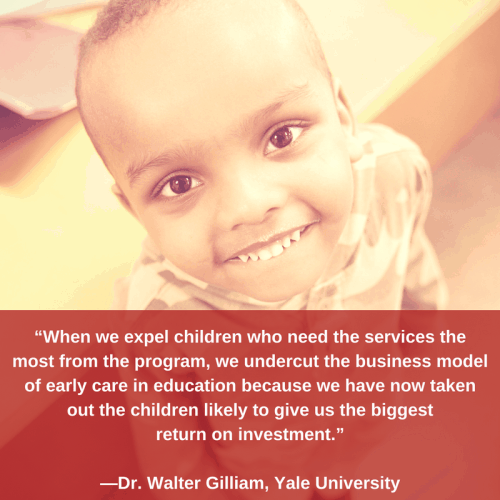
We have a better understanding of how widespread preschool expulsions are thanks to research by Dr. Walter Gilliam from Yale University. In 2005, Gilliam released “Prekindergarteners Left Behind,” a groundbreaking national study that examined expulsion rates in state preschool programs. What he found has helped the field understand the complexity of preschool expulsions and develop ways to prevent expulsion and suspension for young children.

Findings from the Study
After surveying all 40 states that fund prekindergarten programs, Gilliam found that prekindergarten students are three times more likely to be expelled than their K–12 peers. The study also revealed:

  • State expulsion rates for prekindergarteners exceeded K–12 expulsions in all but three states
  • Boys were 4.5 times more likely to be expelled than girls
  • African-American children were expelled at twice the rate of white and Latino children and five times as often as Asian-American children
  • Four-year-olds are 50 percent more likely to be expelled than 3-year-olds
  • Expulsion rates were lowest in public schools and Head Start and highest in for-profit and faith-affiliated centers
What We Talk About When We Talk About Preschool ExpulsionWorking to understand the findings, Gilliam and his team examined teacher bias when it came to observing students. Using eye-tracking technology, researchers presented videos to teachers featuring child actors interacting in a preschool setting. The children engaged in normal play activity without behavioral concerns, but the researchers led teachers to believe children might misbehave. Then they monitored who the teachers watched the most.

Invariably, even in small groups with equal numbers of boys and girls and equal numbers of black and white children, teachers more closely monitored black children, with the greatest attention placed on black boys. This proved true for all teachers regardless of race.

In addition, attempts at reducing bias by providing teachers with details about home and family life made the perceptions about behavior worse when the race of the teacher and student were not the same.

The Impact of Implicit Bias

The Child Care State Capacity Building Center (SCBC) defines implicit bias as follows: “Implicit bias refers to the unconscious attitudes that affect understanding, actions, and decisions. These associations cause feelings and attitudes about other people based on characteristics such as race, ethnicity, gender, age, and appearance. Implicit associations do not necessarily align with declared beliefs.”

The Frameworks Institute makes clear that negative stereotypes are part of the definition, where “implicit bias—the absorption and accumulation of negative stereotypes from media and culture, and the flawed snap judgments that are shaped by those hidden beliefs—is one way that race influences outcomes and creates inequities.”

In Malcolm Gladwell’s 2005 book Blink, he reviews implicit bias test results from Harvard University, finding that “our attitudes toward things like race or gender operate on two levels,” one conscious and one unconscious. He also writes, “The disturbing thing about the test is that it shows that our unconscious attitudes may be utterly incompatible with our stated conscious values.” This means that bias is built in to our thinking, attitudes, and associations, influencing our behaviors and actions in ways we don’t fully understand.

Additionally, implicit biases are more likely to surface when teachers are pressured to make snap judgments or while working in stressful environments with a heavy cognitive or emotional load. Systemically, these kinds of pressures, combined with a lack of awareness about unconscious conditioning, lead to racial disparities in expulsion, skill assessments, and levels of discipline.
What We Talk About When We Talk About Preschool ExpulsionRecent data confirms that disproportionate expulsions continue to grow. 2016 data from the US Department of Education Office for Civil Rights indicate that black preschoolers are nearly four times as likely to be suspended as white preschoolers, an increase over expulsion rates in 2005. Black children also represent 19 percent of preschoolers but 47 percent of suspensions.

Expulsion Prevention in Oregon

When it comes to preschool expulsions, the most recent data available showed Oregon ranks 26th out of 52 state prekindergarten programs. It also has the seventh highest expulsion rate among all 50 states for K–12 expulsions.

In 2013, Oregon removed the zero-tolerance policies in schools and in 2015 passed legislation (SB 553) to limit the reasons for suspension or expulsion. Bill sponsors acknowledged the existence of the school-to-prison-pipeline and the connection between school suspensions and increased risk for leaving school and incarceration.

While that bill focused on students under 12, it didn’t address the needs of kids in preschool, in part because public preschool is largely disconnected from the public K–12 system.

Dawn Barberis, an early childhood specialist/OPK specialist at the Early Learning Division of the Oregon Department of Education, agrees with Walter Gilliam that expulsion remains an adult decision, not necessarily a child behavior problem. “With adequate training for teachers and supports for students,” Barberis says, “we can change how teachers relate to kids and to families, and we can break the cycle of expulsion.” Knowing this, she says, Oregon can create policy that offsets the effects of implicit bias, improves teacher skills related to behavioral and social emotional issues, and delivers resources to early learning providers.

Other states are seeing this opportunity now. Illinois, California, Maryland, and Texas recently passed legislation to protect kids from preschool expulsion, and Ohio is considering similar legislation. Connecticut has not only restricted suspension and expulsion in preschool, it provides free mental health consultation services to preschool programs aiming to improve teacher skills and change how adults address behavior.
What We Talk About When We Talk About Preschool ExpulsionDonna Schnitker, president of the Oregon Head Start Association, adds that preschool classrooms are seeing more children with severe behavior problems each year, more children in the foster care system, and more families struggling with the effects of addiction. Ultimately, she says, kids and teachers need help. “There is always a key that unlocks the behavior or the issue, but you have to have the skills to do it,” Schnitker says. “Teachers increasingly want kids out of their class, but those kids are telling you something and they will respond if we can understand their actions and what’s behind them.”

That takes time and resources. While Oregon needs to better understand its expulsion issues, which will require improving state data, it’s not too soon to pass policy that gives children supports they need to learn.


More Resources

Take Harvard’s Implicit Bias Tests on Social Attitudes

Watch Videos on Preventing Expulsion and Implicit Bias

Listen to our conversation with Dr. Walter Gilliam, co-author of  A Vision for Universal Preschool Education, and the groundbreaking study from 2005 called “Prekindergarteners Left Behind” that examines expulsions rates and the reasons for expulsion in state preschools across the country. 

The Importance of Early Literacy

The Importance of Early Literacy

The Importance of Early Literacy

Materials Provided by the Children’s Book Bank

This week’s visit by the Children’s Book Bank to the Early Works preschool program at Earl Boyles is a good reminder of how important early reading is to young children. Consider that:

  • Eighty percent of child’s brain develops by age 3.
  • Reading to young children can impact how their brains process stories and contribute to future academic success.
  • Children who know more words by kindergarten are better off academically.
  • A child’s reading level in third grade is a consistent predictor of high school graduation and college attendance rates.

For additional information on the importance of early literacy, check out these articles:

The Importance of Early Literacy

Education Week: Doctors Enlisted to Deliver Early-Literacy Message

NPR: Baby’s Got Mail: Free Books Boost Early Literacy

New America: Reading Recovery Program Closing Literacy Gap for Early Readers

Huffington Post: Building Blocks to Literacy

Romper: What Happens In Your Baby’s Brain When You Talk, Sing, & Read to Them?

And if there’s a child in your life who you love to read with, take some time over the holidays to continue working on early reading skills. For tips and resources on how, visit Talking is Teaching, and stay tuned to the CI Blog for some great book recommendations for kids, coming next week!

At Earl Boyles, Parent-Teacher Conferences Foster Community

At Earl Boyles, Parent-Teacher Conferences Foster Community

At Earl Boyles, Parent-Teacher Conferences Foster Community
In a school community where over thirty different home languages are spoken, the faculty and staff at Earl Boyles Elementary in Southeast Portland work to make sure all members of the community feel welcome. Whereas one primary role of schools has been to assimilate immigrant children into a generic ideal that did not necessarily reflect American life, researchers have now come to see the importance of the cultural knowledge that students and families bring with them. Schools that value such knowledge and create authentic relationships with students and families note an increase in children’s academic achievement and emotional development, research has shown. Earl Boyles provides a great example of how to foster these kinds of authentic relationships with all families.

At Earl Boyles, Parent-Teacher Conferences Foster CommunityHead Start, with its Two Generations Together Initiative, pioneered an approach to fostering community and comprehensive child and family services that achieved long-term outcomes by focusing on children and their families. Parent-teacher conferences, which took place at schools across the state this month, including Earl Boyles, are one way for K-12 schools to adopt a family-engaging approach, and create the kind of welcoming environment that has been shown to improve family involvement, as well as to build trust between parents and teachers.

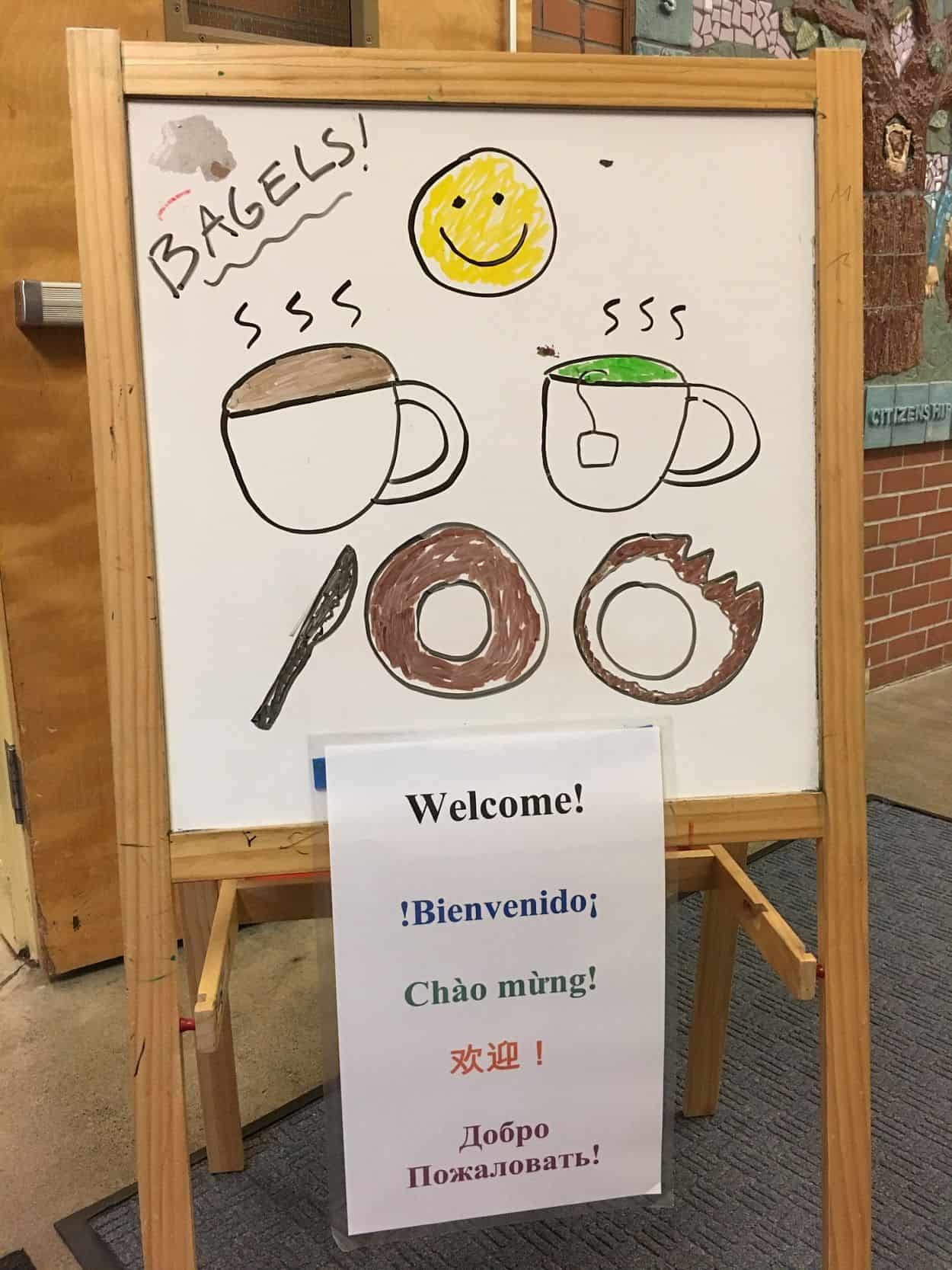
For the past five years, Earl Boyles has implemented a new approach to conferences designed to elicit family involvement and foster a sense of community. While the primary purpose of conferences is still to convey information to parents about how children are doing in school, Principal Ericka Guynes also wanted to use conferences to “create a space that was safe, where parents could start to network, have a cup of coffee, talk to other parents, and access resources.” To achieve that goal, the school incorporated a “Parent Break Space” into its conference model, using the cafeteria as a place for parents to gather throughout the day, and for community partner organizations to provide resources.

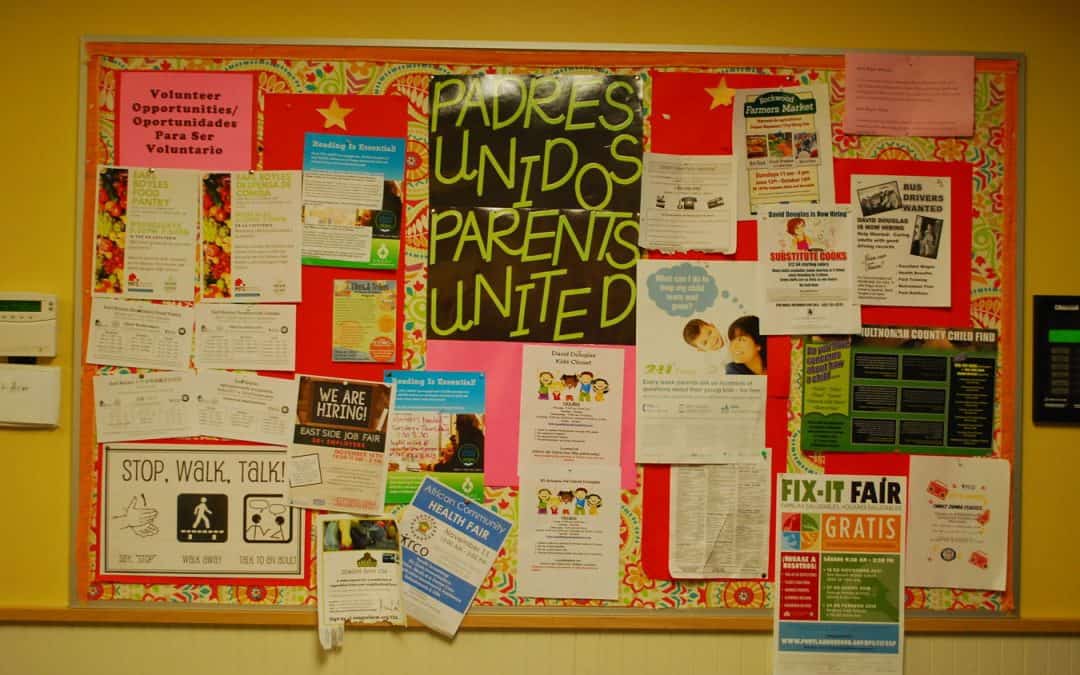
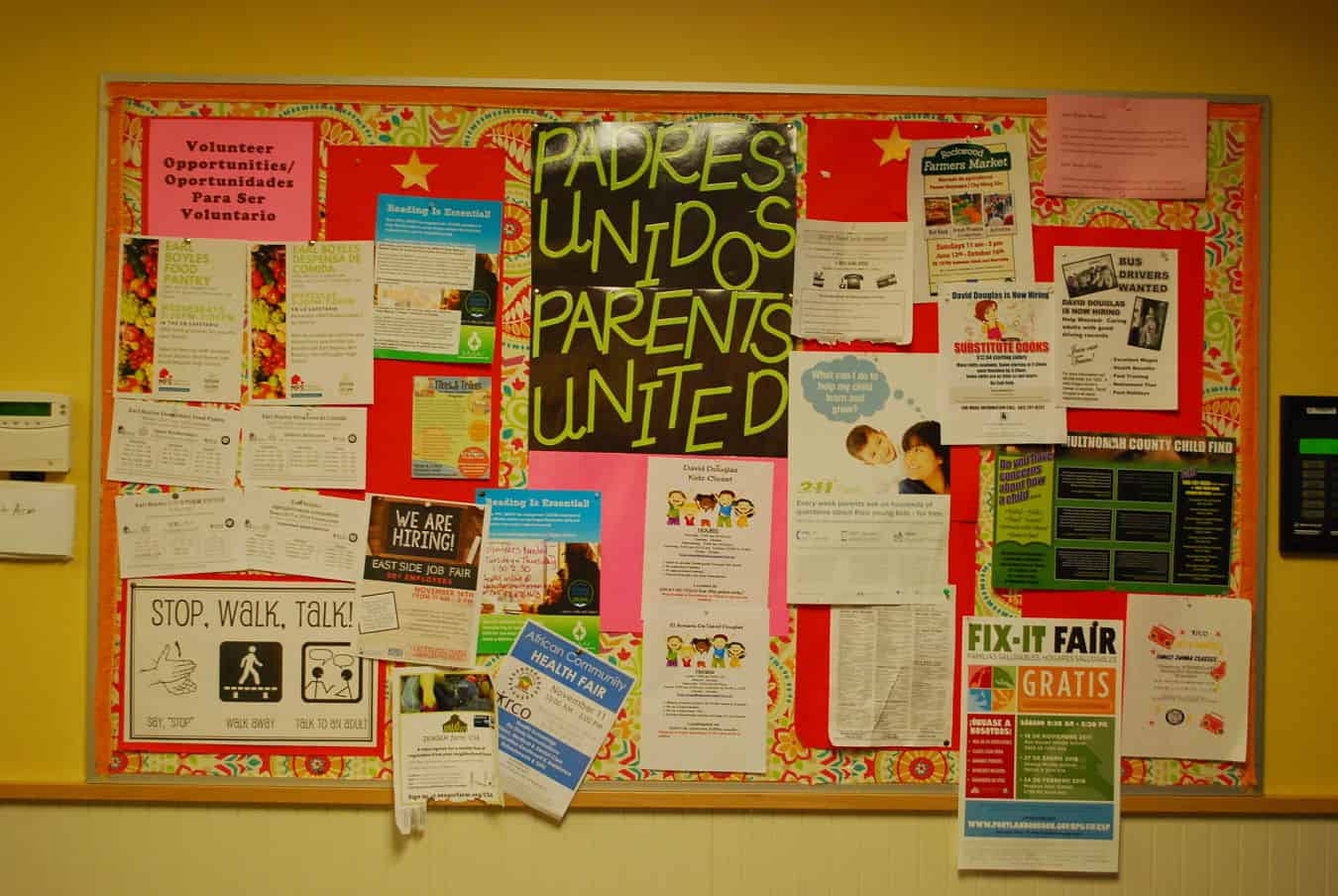
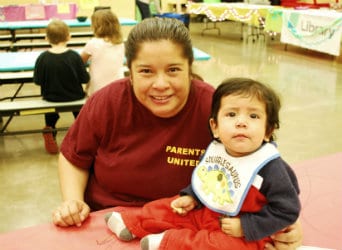
Facilitated by Earl Boyles’ Parents United/Padres Unidos group, the Break Space provides snacks, a place for children to draw, and resources—such as a community health worker, information on housing assistance, and a food pantry—determined by a community needs assessment, and ultimately selected by the Parents United leadership team. In addition to meeting community needs, the school uses the Break Space to continue to communicate with parents, distributing a survey from the community schools program Schools Uniting Neighborhoods (SUN) to determine the adult education topics parents are most interested in.

At Earl Boyles, Parent-Teacher Conferences Foster CommunityAt Earl Boyles, Parent-Teacher Conferences Foster Community


This year, for the first time since the school implemented the Break Space, Earl Boyles will be collecting even more input from parents, working with Portland State University (PSU) to survey parents about the information they received at conferences this year. Principal Guynes is interested in determining whether parents feel as though their voices are being heard, demonstrating that the school views parents as valuable partners in their children’s educations, rather than passive recipients of information during conferences.

The innovation does not end here at Earl Boyles. In the Spring, the school will be using student-led conferences. These conferences allow students to present their work and their future goals to parents, and teachers more time to connect with families. These new approaches to conferences demonstrate how small changes within a school can help build a welcoming school community that supports young children’s learning experiences.

At Earl Boyles, Parent-Teacher Conferences Foster Community

At Earl Boyles, Parent-Teacher Conferences Foster Community

The Power of Head Start: A Parent’s Perspective

The Power of Head Start: A Parent’s Perspective

Angela Parsons gives us a parent’s perspective about her experience with Albina Head Start in North Portland. She talks about how her son made great strides with his academic and social emotional skills during two years in preschool, her renewed interest in Spanish thanks to the school’s focus on learning multiple languages, and her confidence in the school to keep her son learning and get him ready for kindergarten.