Supporting the Early Childhood Workforce: Alga’s Story

Supporting the Early Childhood Workforce: Alga’s Story
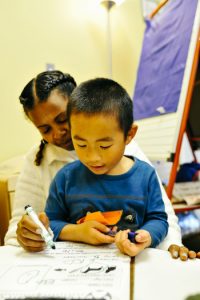
Weldeindrias works with a student while volunteering in Katie Wiegel’s classroom.

“Alga, you always had your work prepared to bring to class and you took your academic responsibilities very seriously,” says Yolanda Buenafe, early childhood education instructor in Mt. Hood Community College’s Assistant Teacher Career Pathway program. “Your questions were very focused on what you wanted to accomplish.”

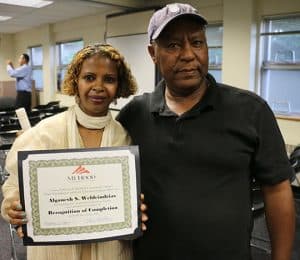
Alganesh Weldeindrias smiles as she listens to her teacher’s praise. Today is her graduation day, and she has earned a certificate from Mt. Hood Community College qualifying her to apply to the Oregon Registry for her Child Development Associate, or CDA. Not only has she completed her certificate program, but Weldeindrias had perfect attendance, attending the program four nights per week for ten months, and earned a 4.0 grade point average. She is now qualified to be an assistant preschool teacher in Oregon.

Weldeindrias says she loves working with children and is thrilled to make a career of it. “They’re funny and they’re innocent,” she says. “And they make me feel good.”

The Mt. Hood Community College Assistant Teacher Career Pathway program has operated for two years, with funding from Oregon’s child care division, to support people working with young children move up in their careers.
Supporting the Early Childhood Workforce: Alga’s Story

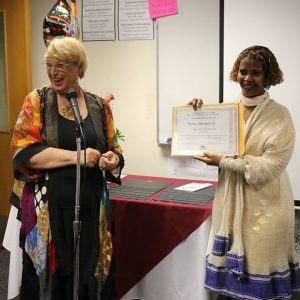
Weldeindrias receives an award for perfect attendance. Four nights a week for ten months, she never missed a class.

The program is a very successful example of how Oregon can diversify and professionalize its early childhood workforce. The state can build up existing human capital in communities by connecting people who work with young children to resources and educational opportunities.

Students like Weldeindrias and her fellow graduates are an example to Oregon of what can result when the state supports a true pathway to educational achievement in the field of early learning. As the state implements high-quality preschool programs like Preschool Promise, it would do well to increase investments in similar Career Pathway programs around the state. Research shows that high-quality teachers are both well-educated and representative of the students they teach. The Career Pathway program and others like it are sound state investments because they result in high-quality teachers.

“We give students the opportunity to take college early childhood education classes to earn a certificate that’s part of an early childhood education degree,” says Angelique Kauffman-Rodriguez, Career Pathway Specialist.

The program also helps students gather hours in the classroom, prepare their portfolios and study for an exam. Successful completion of these elements, in addition to being observed in the classroom, qualifies the students for their CDA. Graduating students who wish to continue their education, like Weldeindrias, are already halfway to an Associate’s degree.

“We’re developing a next-level program to help students earn their Associate’s degree because of demand from successful students over the past two years,” says Kauffman-Rodriguez.

In addition to early childhood education courses, the Career Pathway program provides support around college-level learning skills, including writing and studying. Because of the state’s funding, the students also receive scholarships covering the full cost of tuition, textbooks and exam fees. These supports are critical to the program’s success, and this year 11 students completed the program.

Weldeindrias is thrilled with what she’s learned. “We learn how to guide the children,” she says. “Social emotional, physical, cognitive, how to support the kids.”

She says that her most useful lesson has been the importance of understanding children’s feelings. “We have to understand their actions, why they do what they do. We have to listen and be at their level.”

This is a lesson that Weldeindrias has even put to use at home, with her own three sons.
Supporting the Early Childhood Workforce: Alga’s Story

Weldeindrias and her husband pose with her graduation certificate.

“I used to use a lot of time out for my kids, but it’s not helpful,” she says. But now when they fight or act out, she has a conversation with them about what is really bothering them. “If they have a problem, we solve the problem.”

Roni Pham, professional development specialist at the Oregon Department of Education’s Early Learning Division, spoke at the graduation ceremony to share this vision. “I’m really glad that the Early Learning Division had an opportunity to provide funding for this,” she said to the graduates. “You did exactly what we knew you would do. This is what we said this program was capable of producing.”

After the graduation ceremony, Weldeindrias posed for photos with her classmates, her family and with Earl Boyles Elementary preschool teacher Katie Wiegel, whose classroom she has volunteered in for the past two years.

“I like Earl Boyles,” Weldeindrias says. “It’s where my kids are. I would love to work there!” She has applied for an open assistant teacher role for the fall.
Preschool Promise: High-Quality Preschool for More Oregon Kids

Preschool Promise: High-Quality Preschool for More Oregon Kids

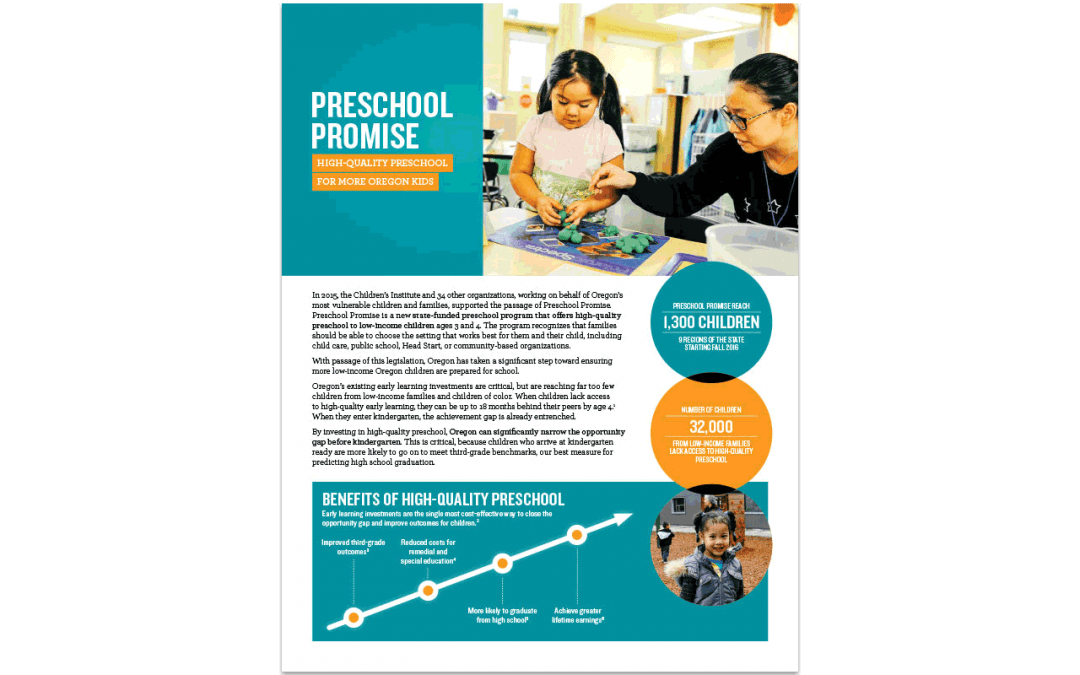
Preschool PromisePassed by the 2015 Legislature, we are excited that Preschool Promise will begin serving 1,300 children from low-income families in September. The program opens the door to diverse high-quality preschool providers and gives families the opportunity to choose the setting that best meets their needs.

This investment is an important first step, but there is more work to be done. More than 32,000 low-income children in Oregon still don’t have access to high-quality preschool, and effective implementation of Preschool Promise will require collaboration and support for providers. It is our hope that this brief provides insight about how to reap the benefits of Preschool Promise.

We also hope it inspires leaders and partners who share our vision of giving more children a strong start in life to join us in calling for ongoing investment in Preschool Promise.
Read Report >

Creating an enviable life for all kids: A Q&A with Nancy Anderson, retiring early intervention and special education leader

Creating an enviable life for all kids: A Q&A with Nancy Anderson, retiring early intervention and special education leader

Nancy Anderson and Early Works partners visit South Shore School in Washington state.

Nancy Anderson, who leads Early Intervention and Early Childhood Special Education services in Multnomah, Hood River, and Wasco counties, is retiring after 40 years helping children achieve success. Although Anderson holds titles with both the Multnomah Early Childhood Program and the David Douglas School District, her work has spanned much more than these titles alone suggest. She is admired statewide for her leadership around professional development, has been an integral thought partner for educators and administrators, and has played a key role in the creation and success of the Early Works initiative at Earl Boyles Elementary. There she helped create a preschool that was funded by multiple agencies, including MECP.

The Children’s Institute is grateful to Nancy Anderson for her years of public service, dedicated to improving all children’s lives. “Nancy was fundamental in launching the Earl Boyles preschool program and in advocating for full inclusion of children with special needs in a universal preschool setting” says Swati Adarkar, President and CEO of Children’s Institute. “Nancy has been a key partner, not just for the Children’s Institute and Early Works, but across the state. She has pushed everyone to innovate, and has fought hard to improve the odds for all Oregon kids.”

“Nancy has been a leader in EI/ECSE since the very early beginnings of this statewide program,” says Anderson’s colleague Judy Newman, the Co-Director of Early Childhood CARES and a member of the governance consortium for Lane County’s early learning hub, the Lane Early Alliance. “She is a critical thinker and innovator, always striving to stay improve services and supports based on the current evidence in the field. She asks important questions and challenges us all to constantly evaluate what we are doing and to grow and change as needed.”

We talked with Anderson about her career, the current state of early intervention in Oregon, and what policymakers can do to ensure all kids have an equal shot at success.

CI: Why is the interplay between early intervention and early childhood education so important? For example, why should preschool teachers in public settings be dually accredited in special education and preschool?

NA: When I think about early childhood or our K-12 systems, kids come to us from wherever they are – there is a lot of diversity. If you have a group of 20 kids, 17% of them have a delay or disability, and/or are dual language learners and/or have experienced trauma. So what do staff need to do be able to deal with that? Teachers need to know enough in each area to be able to [address the diversity of issues]. That is where the importance of dual accreditation comes from – if the teacher has no background in knowing what to do with students with special needs, having a special education specialist come in once a week isn’t going to make a big difference. For kids with disabilities, inclusion early in school sets the stage for inclusion later and leads to greater success for graduation rates and career success.

CI: What has been your role in Early Works and the preschool at Earl Boyles?

NA: Years ago we first sat down with Swati Adarkar and a group of partners from around the county, asking what do we need and where should we do it? We decided to move forward with a preschool in the David Douglas School District. The Community Needs Assessment for the area showed that, out of all the things, the community really needed access to preschool. So we thought: If we built a preschool model what would it look like? We wanted the preschool to service all the kids in the catchment area, so we could impact the trajectory of kids prenatal to age 3 [P-3], and into the K-12 system. We worked to include kids in Head Start and Early Childhood Special Education. All of the detail work to get the preschool started was really complicated, hard work. You really have to have people who want to figure it out and who are willing to do hard work. But does it need to be done? Yes.

CI: Tell us about your statewide leadership around professional development.

NA: Last year, [Former] David Douglas Superintendent Don Grotting and I went to the Oregon Department of Education to offer a summer institute for professional development that would be open to anyone in the state. We created the institute in partnership with the Early Learning Division, Oregon Department of Education- Early Intervention/Early Childhood Special Education and the David Douglas School District. It was phenomenal. It was so popular that the department wanted to do it again this year, and extend it to an entire week. This year’s institute is offering seven courses on topics like coaching, dual language learners, and positive social emotional development. Educators from all sorts settings attend – child care, K-3rd general education, community preschool, Early Intervention/Early Childhood Special Education, and Head Start.

We learned people are really hungry for P-3 professional development and learning – and for something that isn’t just a day long.

CI: What are you most proud of having accomplished in your career?

NA: There isn’t any one project or initiative. It is probably more that I’ve always tried to ensure that kids and families have a shot at a full life – both at school and in their community. My focus has always been on making sure kids and families have what they need to be successful and have an enviable life. And think I’ve been pretty successful in making that happen!

CI: What drives you to push innovation at both the state and district levels? How have you gotten partners, teachers, parents, others, to buy in to early childhood investments?

NA: One of the things that makes a difference is to share some different experiences with them – show them what is positive and possible. People come to their work with certain experiences or lenses – and sometimes just don’t know what is possible! One of my biggest jobs as a leader is to really make sure I am bringing forward those stories and experiences of the partners and families we are working with to support their hopes and dreams.

For example, when talking to a parent of a young child with Down syndrome, they may have a dream of their child attending college. However, people in their life may be telling them it’s not possible. I might say ‘Oh! I hear you thinking about your child attending college in the future. Do you know that Northwest Down Syndrome Association is working with local colleges on a program called “Think College” which ensures students have access to college? It is possible!’ You have to kind of change the conversation.

And that is what Early Works has been about – showing people that it is really possible. At Earl Boyles, parent engagement has changed and they are getting great outcomes. It is important to share these stories and also share the data that shows things work. Once you put vision and outcomes together it is hard to say no.

CI: What is the number one thing parents and teachers could do to help more students succeed?

NA: For staff, kids, and families, the recognition that “this isn’t it.” There is always more to do. Things can be better. And when we bring people on board who understand that, we can always do even more.

CI: What is the top thing policymakers could do to help more students succeed?

NA: To ensure that whatever policies are being made to ensure kids have that best start – that it includes all kids. That when we say “all” and “every” that we really do mean “all.”

Partnership strengthens preschool in Yoncalla

It’s late morning on a sunny Wednesday in Yoncalla, Oregon and 14 preschoolers are gathered on a colorful alphabet rug. Most are cross-legged, but several are wiggling, struggling to contain their excitement. All eyes are on Jill Cunningham, the Yoncalla library’s branch manager, who has come to visit their classroom at Yoncalla Elementary. They are singing This Old Man together, complete with hand motions.

“What rhymes with three?” Cunningham asks, holding three fingers high.

“Tree!” A girl in pink shouts.

“I like it,” says Cunningham.

“He played knick-knack on his tree,” they sing.

Cunningham is a frequent visitor to the preschool class, which is taught and operated by lifelong Yoncalla resident Cassie Reigard. Reigard is operating the preschool that was started decades ago by her grandmother – who just recently passed away. Reigard’s mother ran the preschool after her grandmother, and Cassie took over when her mother retired.

The Yoncalla school district provides space at the elementary school for Reigard to operate the program. And this year, the partners that are part of the Early Works initiative at Yoncalla have supported Reigard to receive professional development and assistance that will help her students be ready to succeed in kindergarten. Teaching preschool is in Reigard’s blood and she is a great person for Early Works to support. After all, she has dedicated her career to Yoncalla’s young children.

Partnership strengthens preschool in Yoncalla“I love the kids. I love watching them learn; I love teaching them,” Reigard says.

The professional development and help that the Yoncalla School District and other Early Works partners have provided Reigard has resulted in a new opportunity for her to serve more kids from low-income Yoncalla-area families. The South-Central Oregon Early Learning Hub – its service area includes Yoncalla – was one of nine early learning hubs in Oregon that last month was awarded some of the new state funding to support high-quality preschool for children from low-income Oregon families. Some of that funding now will be going to help kids in Yoncalla.

The Children’s Institute has worked closely with the state to ensure the passage and develop the program, called Preschool Promise. The program will support high-quality preschools in a mix of settings, including public schools, Head Start and private, community-based programs.

Jan Zarate, Yoncalla School District superintendent, said Reigard and the school district submitted a joint application for the Preschool Promise funding; the South Central early learning hub plans to fund their effort. “We are going to get the opportunity to pull more partners to the table and do more braiding of funds” says Jan Zarate, Yoncalla School District superintendent.

When she heard the news, Reigard says, she was ecstatic. “I feel very excited for the children in our community and the opportunities this will provide for them,” she says.

Zarate says that while the support from the school district and other Early Works partners was important in helping to secure the Preschool Promise funding, so was Reigard’s experience and foundation in the Yoncalla community.

“Cassie’s capacity to build relationships with people and make them comfortable is amazing. Parents trust her,” says Zarate. “There are also areas to grow and there is a personal commitment on Cassie’s part to know more and be even better prepared.”

Reigard says the Early Works support for her professional development is very helpful. “I’m always open to improving anything that I can,” she says.

Partnership strengthens preschool in YoncallaAt a recent conference at Umpqua Community College in Roseburg, she learned some new strategies to help her students understand the reasons behind their feelings. “I’ve struggled with some students in class that don’t know how to handle their feelings and so I’ve really been able to take them aside and talk about their feelings and really just work on supporting them emotionally,” she says.

A very important new tool was added to Reigard’s teaching arsenal this spring: the Ages & Stages Questionnaire, or ASQ. A developmental screening survey that is simple for parents to complete, the ASQ pinpoints developmental progress in children up to age five, allowing teachers, caregivers, and service providers to understand what individual supports a child might need to be healthy and ready for school.

Almost all of the preschool parents agreed to participate, and Reigard loved conducting the screening survey. “It was one of the best things I could have done to develop a more personal relationship with parents and to understand their children better,” she says.

In addition to relationship-building, the screening survey helped Reigard tailor her instruction to her students’ needs and interests. “Not only did it show what I need to work on in specific areas with the students, but it clarified reasons why some students were more behind than others, not just academically.”

Finally, the screening survey led to Reigard being able to refer several students to additional programs and services that will help the students in their learning.

In the future, Reigard plans to conduct the ASQ screening in the fall, ideally even before school starts, to inform her teaching from the beginning. “My goal is to connect with families and work together with them to help prepare their children for kindergarten,” she says.

Early Works is focused on supporting Reigard, and other teachers and service providers in Yoncalla, to learn and hone new strategies to help students succeed. At the same time, the Children’s Institute is working hard at the state level to help advocate and secure funding for programs like Preschool Promise.

Oregon Announces Preschool Promise Awardees

Oregon Announces Preschool Promise AwardeesLast week, Oregon’s Early Learning Division announced their Preschool Promise award recommendations. The announcement marks an important step in the state’s process to increase publicly funded preschool opportunities for low-income children in Oregon. Preschool Promise, or House Bill 3380, was passed by the Oregon Legislature in 2015 with the goal of providing high-quality preschool in a variety of settings. Preschool Promise expands the types and number of providers that can receive funding for high-quality preschool programs in the state, and increases the number of families and children that are able to access the services. Early Learning Division staff estimate that the implementation of Preschool Promise will mean that approximately 1,300 more Oregon children will receive high-quality preschool in the 2016-2017 school year.

Gwyn Bachtle, an Early Learning Specialist in the Early Learning Division described the visionary goal of the new program as, “having children in programs that are quality-rated…and really working to increase the capacity of our communities.”

An award team, composed of state executive staff and three Early Learning Council members, reviewed applications from Early Learning hubs around the state. The hubs will be responsible for contracting with local providers and implementing the new preschool programming in their communities. Applications were evaluated based on demonstrated need; the capacity to support a mixed-delivery model; and the capacity to support high-quality preschool programs.

In total, ten hubs submitted a total of seven applications (one application was a joint application including multiple hubs) – with their combined requests reflecting the preschool needs of more than 2,600 children. Five of the seven applications were approved for funding, and these hubs will be working with the Early Learning Division closely in the upcoming weeks and months – gaining technical assistance and finalizing contracts with providers.

Awardees of 2016-17 Preschool Promise funding

  • Marion and Polk Early Learning Hub:
  • South-Central Oregon Early Learning Hub
  • Lane Early Learning Alliance
  • Southern Oregon Early Learning Hub
  • NW Regional Joint Application
  • NW Regional Early Learning Hub
  • Early Learning Washington County
  • Early Learning Multnomah
  • Clackamas Early Learning Hub

The Preschool Promise announcement is, as Molly Day, Early Learning Multnomah Director says, “a big deal. The state is deciding to invest in preschool, for its residents who are furthest from opportunity. Families in poverty, families that aren’t being served now…it is a lot of change all at once, and that makes it challenging, but it is a wonderful opportunity.”

“We hope this is just the beginning,” says Dana Hepper, Children’s Institute Director of Policy and Program. “There are many disadvantaged Oregon children who still lack access to high-quality preschool.” In fact, three-quarters of Oregon’s young children still don’t have access.

“The Children’s Institute is supporting the state to ensure successful implementation of Preschool Promise,” Hepper says. “We look forward to seeing the program grow.”