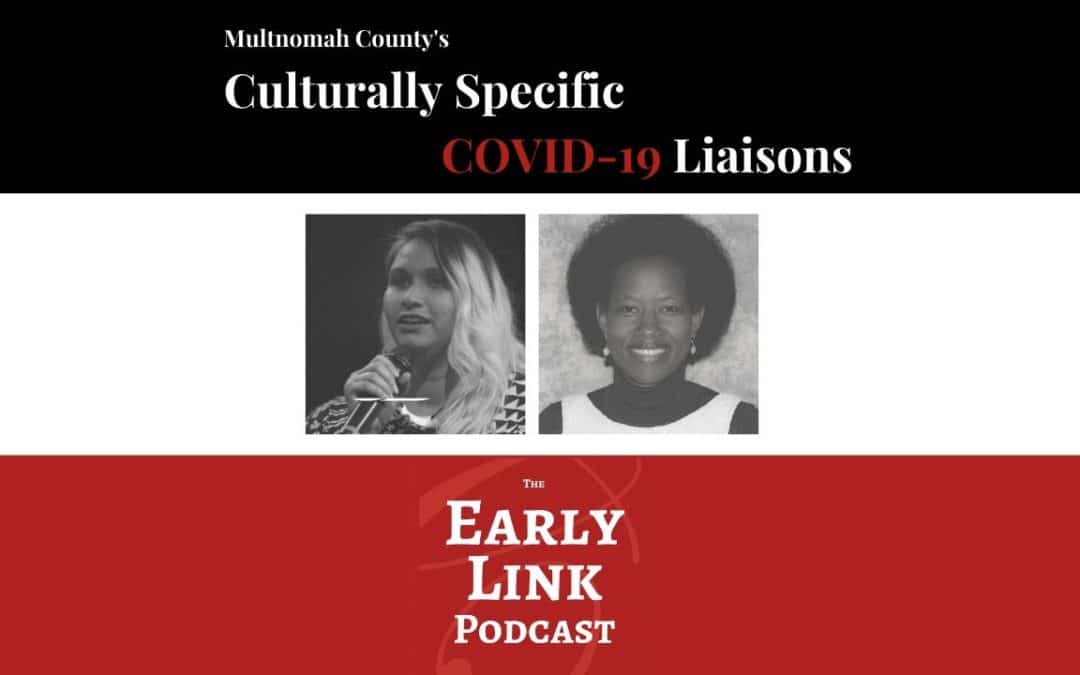
Rafael Otto: I know that you have your roles with the Portland Bureau and the Multnomah County Health Department, but you’re also serving as culturally specific COVID-19 liaisons. Can you tell me what that means? Regina, could you start for us?
Regina Ingabire: This role – culturally specific COVID-19 liaison – was created at the Multnomah County Emergency Operations Center at the beginning of March. The goal was making sure that we can be point of contact for culturally specific organizations and individuals to make sure that we are sending updated information because as you know, information was changing really fast. Those culturally specific organizations kind of surveyed back information to us, what they’re hearing from the communities, their concerns.
Rafael Otto: Virginia, what does that look like for you?
Virginia Luca: Yeah, I’m, before I share, I also want to acknowledge that Beth Poteet is the third liaison that we have. So I wanted to give a special shout out to her.
Other than checking emails and responding to folks, the biggest share that I do is the communities of color, COVID-19 partner call. That happens every Thursday in which we have about 116 folks from the community come in to share resources, catch up on what people are doing and trying to find out what is the best ways that we can help our community members. Which, of course, when we hear feedback, then we have to do something with it, right?
We have to pass it on to whoever it needs to go to. We have to find out why isn’t it being done already. Is there already a system that’s doing it? So there’s a lot of untangling that happens. There’s a lot of background information that happens and because we’re trying to do this work from our position in a larger model, always trying to understand the system and making sure that we are honoring the community voice and we’re honoring the community for what they’re needing. What can we do to uplift their voice and their needs from their standpoint.
Rafael Otto: Could you talk about key priorities, needs and challenges within communities that you’re working with? What are you seeing?
Virginia Luca: Before I was on this cultural liaison work, I was doing Pacific Islander-specific research and community engagement. I feel like I can speak pretty clearly about the Pacific Islander need in Multnomah County and Oregon. Even before COVID-19 happened, we already had our disparities. We already had lots of things in our community that they we were not having access to that were, where there were barriers. COVID-19 just made things even worse.
The way we collect data does not help everybody because we don’t disaggregate in a way that is informative for our specific communities.
It isn’t easy to just go to a website and find out how many people, Pacific Islander communities have COVID-19 and Multnomah County, Yamhill, Clackamas, Marion, because each county has its own separate way of collecting things and sharing it out.
It’s hard to tell the story of the community if we don’t have the data to back it up. And vice versa. So many times we, I’m hearing things from my community that is not being reflected in the data
It’s our responsibility to make sure that the stories are uplifted-the story and the data need to work together.
Rafael Otto: Regina, what are you seeing?
As Virginia states, it’s true, for most of these communities, the coronavirus made things worse in so many ways. People are finding hard time getting food into their homes and also there is a lack resources to help their children continue their education at home. As most of education right now is online, parents who don’t have the technological savvy to know how to support their children, and some parents cannot read or write themselves.
So now you can imagine that in the long-term, the impact it’s going to have on the children when the schools are back in the fall. We try our best to connect [communities] to existing resources and the school districts they are coming from but still there are challenges there. And the challenges we hear from the community is how to take care of someone who has COVID-19 at home. Some of these communities could be living in a small space, a small house or apartment. How do you make sure they are taking some care of someone without exposing the rest of the family members? The challenge is real. We’re doing our best.
Rafael Otto: The needs are many out there. I would also imagine that in some cases there’s, from the health perspective, there’s a language need. How are you thinking about that? Virginia, I know you touched on sort of that systems view. What does that look like?
Virginia Luka: One thing that we struggled in in the beginning was we have all of the messages usually come out in English right? Automatically. And then, you know, people deciding, well, what other languages should we advocate for this, you know, message to be translated into and having to advocate for Pacific Islander languages. People might not even realize that we have a large Chuukese population, a large Marshallese population.
Normally only people who are doing work in that community know what the language access is. And kind of showing people that when we do translations, it’s not a word for word. You can’t just give me something in English and have it translated word for word into a Palauan language – that’s, that’s my ethnic group, my mom’s from the Island of Palau.
There has to be this back and forth communication of, “What are you trying to convey? What are you actually trying to have people do?” And then from a cultural perspective of what other underlying things do I have to point out that maybe in an English form you’re kind of reading between the lines already. And having to know what culturally specific way do you need to convey this information cause it’s not just enough to tell people to wear a face mask. You know you have to also say things like, you know, it’s not a good idea to share the face mask. This is how you should take care of the face mask.
You have to be very specific and try to think of ways that our communities, our immigrants and refugees are going to take that information, even in their language, how they’re going to compute that information. At the end of the day, we want them to be safe and secure. What is it that we have to say to make sure that is understood?
For my community, the Pacific Islander community, some of these directives don’t work for multigenerational households. For example, I have a friend who lives in a house with 12 people and two bathrooms, three bedrooms. So, you can’t tell people to self-isolate, be in your own room. We are still taking care of children. We’re still taking care of our elders. My 80-year-old mother lives with me.
When I read a directive, I have to say, well, this doesn’t really work for my community. This doesn’t work for my own household. Right? You’re asking [people] to do something that I can’t even do my own home. So constantly thinking about what are ways that our messaging has to be community informed and community driven and even community created. It should start with the community because it’s for the community.
Rafael Otto: That makes a lot of sense. Regina, do you have comments on that?
Yeah, just to touch base on what Virginia said, it’s true. We try our best to translate information into different languages to make sure that I can reach the wider audience. I’ll give you a quick example. We created a poster which had information about how to stay safe and also created videos. We then translated those into 37 languages. That was a very successful project in terms of reaching out to the communities. However, as Virginia said that when you translate a message from English to a different language, there’s likely a piece that is missing. So you need to elaborate.
Information moves really fast. It’s evolving every day and sometimes no matter how much we try there is a delay because we can’t keep up with all the information coming out. New guidelines are coming back every day and we try our best. Each day we send information out to our community contacts. We have about 1,400 contacts or even more, and we ask those community members to share that messaging directly with their community members and maybe translate where it’s possible.
Rafael Otto: Have you seen the need to be addressing myths or questions around COVID-19? I know that things that have been circulating, like certain foods will prevent it or certain people are immune from it. Those kinds of things. What are you seeing along those lines and how are people, like, what’s the efficient form of communication for communities? How are they sharing that, those kinds of things?
Virginia Luka: I was on a Zoom call, I think it was two days ago, and one person said like, I heard that it’s caused by 5G.
That the 5G network is the reason why we have COVID-19. I remember saying we need to use true information, real evidence from people that we trust, people who do this for a living, you know, researchers, scientists, we need to make sure that when these things come up, that we are saying something.
I know that one way a lot of these myths are shared are through social media. I’m not huge on social media myself, but I definitely have had people tell me things like, “Oh my gosh, this, did you hear this?”
I’m like, please do not spread this information because you’re actually harming our community by, by spreading these things that are not true. Let us focus on things that are true, that are evidence-based, that are from reliable sources. I just try to tell people to question. Where did you get that? Where did you hear that? That we have this other narrative that I do believe and if you can help me spread that, that would be great.
Rafael Otto: Regina, what kind of things are you hearing?
Regina Ingabire: I heard from the East African community of immigrants and refugees a myth that this is another form of Ebola. So to be able to say that this is not Ebola, this is coronavirus, they have different symptoms. This one is actually spreading really fast. Just to make sure that we’re providing a sense of calm, really providing information that’s needed. It’s always important to debunk that myth as soon as possible because that person can influence the community too.
Rafael Otto: That can be such a tough process because those kinds of things arise really quickly. How do you stay on top of all of those different kinds of messages?
Regina Ingabire: I found out working directly with the community partners, it helps us to be able to reach out to community members and communicate information as soon as possible. Otherwise, we just rely on our other ways of disseminating information to the people, you will be too late. But these culturally specific community leaders are very key in terms of getting information out and back to us to like, this is what we’re hearing, how can we make sure that our community is getting the right information right away.
Rafael Otto: How are you thinking about building community resilience in these times?
Virginia Luka: How I see it is reminding our community of the strengths that they have. So many of us who are people of color, indigenous people, there are so many narratives that you know, a lot of us statistically shouldn’t be here. Because of institutions in place to make sure that people like us don’t survive, that there is no next generation for us.
As someone who is Pacific Islander, you know, hearing stories like my mom being born during World War II in Palau with Japanese rule, while you know, had to hide in caves while the United States was bombing the islands and having to rebuild because a lot of the bombs had torn up the taro patches, polluted the lagoons where they go fishing. We talk about the ways that we have survived and that we will continue surviving.
Yes, it’s really hard. And it’s not to downplay that this is not hard, right? Let us think about the ways that we have gone through things in the past and what are those practices that we can do right now? What is medicine in our life? Cause we don’t always practice things from a Western point of view. Making sure that my mom has enough ginger and lemon for her daily tea. That’s her medicine. Making sure she has enough Vicks and coconut oil to rub all over her body. That is medicine. So constantly thinking – what are the ways that we have thrived?
And how can we uplift that and make sure that we don’t forget who we, we don’t forget where we came from and that we are strong and resilient people.
And that’s only one way. And then you have to actually have systems in place to support.
I sit on the board of APANO, the Asian Pacific American Network of Oregon, and when COVID-19 was coming up, they were able to find ways to get grants from different community organizations, banks to the communities who are in need.
For example, these phone calls, these Zoom calls, right? I am not normally someone who likes to be on a digital call. I’m from a population of people that wants to be in the same room together. We want to smell the same air together. We want to touch each other and hold hands and eat. That is our medicine. That is how we connect. That is how we show we love each other and this is very hard. But that doesn’t mean we don’t meet, we still continue to meet in new ways in order for us to still be in community.
Rafael Otto: Regina, what are your thoughts on building community resilience?
What we’re planning to do and continue to do is to have that relationship with the existing community based organizations knowing that they have that strength, they know what the community needs. As government agencies, we need to listen to them and value what they say. We as key stakeholders to make sure that we work together closely, not just to meet the needs of the people, but to do our part as individuals, as community to make sure that we can survive. At the end of the day to make sure that there’s that collaboration, that acknowledgement of what everyone brings on the table.
I know the city has shared out a lot of economic relief programs so we can disperse funding back to the community based organizations. Just rethinking resources that so we make sure that no one’s left behind.
Rafael Otto: What would you say are the avenues for community voice and making sure that government or institutions or systems are actually listening to the communities? What are the best ways to make that happen? What are the avenues for which community voice can be elevated?
Regina Ingabire: I know from Multnomah County they’ve organized a press conference with Dr. [Jennifer] Vines, to listen to the community members who speak Spanish directly and ask her questions directly.
I think what that helps is a community understanding that now we have someone who is speaking to us, responding to us and she’s hearing from us direct as well. I think that builds that trust and bond knowing that the communities are not left by themselves. And I know Mayor Wheeler has also been communicating, having those press conferences on Zoom to hear from community members and the community organizations and the city. When you provide that space and time to listen to community needs, in the end, not only do you build trust, you show true leadership.
Rafael Otto: Virginia thoughts on that?
Virginia Luka: In the Pacific Islander community in Multnomah County, we have something called the Pacific Islander Coalition. It’s made up of Pacific Islander-serving organizations. And because we are a smaller community, we tend to have the same leaders show up to the same table and people in the community have some kind of personal connection with them.
I’ve been a community leader for so many years, even before I started at Multnomah County, people know my telephone number. I get personal phone calls, you know, people share my number, I get phone calls from family who are like, Oh, you know, my daughter is going to be applying to Portland State University. Can you tell her how to apply? I think it just shows how connected our community is. It really is about relationship – relationship and connections. Because of the trust building we’re going to the people right now that we trust, that we see stepping up, that we see who have been active leaders, that are the go tos. Right now in my community, that is how things are getting done.