Exploring Community and Early Learning in Eastern Oregon
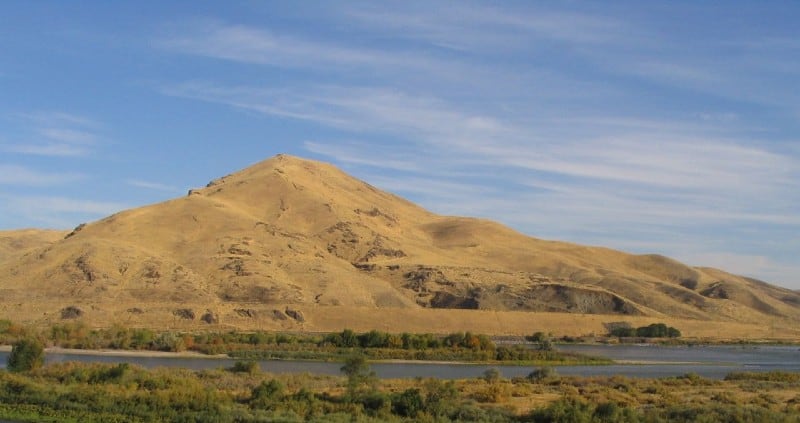
Eastern Oregon held answers to several questions swirling in the universe of early education. It was hard not to take note and stay focused as we left our Portland urban core, and headed towards rural and frontier communities in the eastern region of the state.
The purpose of our journey was to listen and learn from one of many Oregon communities doing transformative work for young children and families, and adapting approaches that are well researched and proving successful. Connected to this is Children’s Institute’s aim to amplify, develop, strengthen, and transform the emerging early childhood system to create a socially just and equitable Oregon for all children. This is not just words on a page, but rather the pathway that led us here.
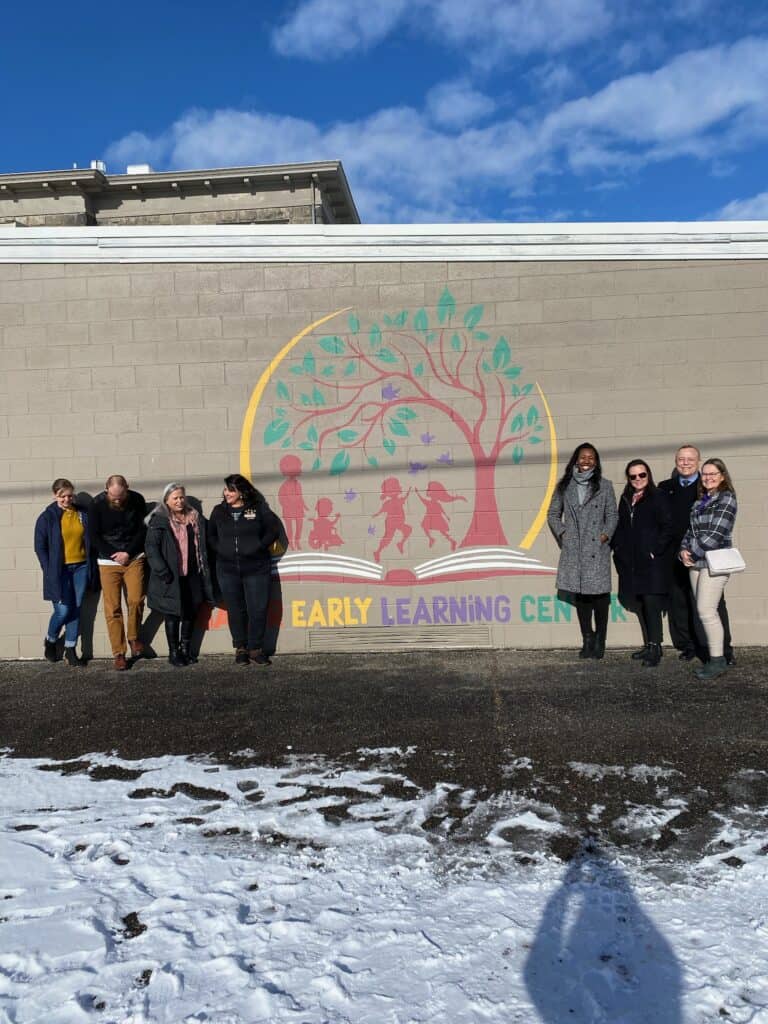
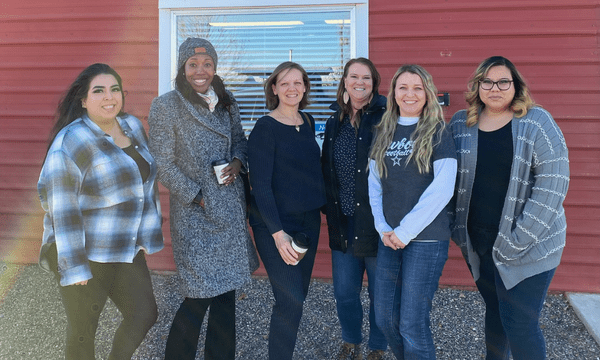
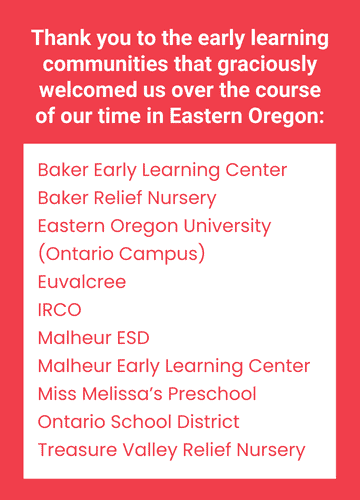
Our trip to Eastern Oregon was immersive and led us to several early learning sites in Ontario and Baker City, including Euvalcree, Baker Early Learning Center, and Treasure Valley Relief Nursery, among others. We were also able to connect with the Ontario School District, one of our Early Learning Academy partners working on building robust early learning and care in their district.
We saw the remarkable fortitude and dedication of a community that is creating safe spaces of belonging for children, building workforce training programs and career pathways, and diligently working toward a seamless early childhood network.
There are innumerable stories to share, and we must a shine light on the lessons we took with us. These learnings are salient and timely with a new legislative session underway, and incredible efforts to stabilize and support children and families in the near term.
Learning #1
Sometimes, policies that help our urban centers may hurt our rural partners—a truth that further substantiates that one-size-fits-all approaches don’t work. This is true for both policies and programs. As such, all policies should be evaluated for the adverse impact they have on both communities of color and rural communities, and the intersectionalities in-between.
In communities of color, we acknowledge and say this often. Many systems of structural barriers are not designed for us and as such, the programs that are developed “for us and by us,” tend to be more effective. The same is often true for rural areas. Our systems and policies are often developed by folks outside of these communities and thus, don’t reflect their lived realities. Leaders in the state must increase representation in the decision-making process and consult with our diverse communities to better ensure impact.
Learning #2
Communities are resilient. We need to rewrite the narrative of our rural communities, one that focuses on their assets and resilience; not their trauma and deficits. A soon to be released survey from the Oregon Values and Beliefs Center on early childhood perspectives shows us that these issues are of paramount importance to Oregonians across the state, including our rural and frontier regions.
Learning #3
We don’t get out of the I-5 corridor enough! And by we, I mean those of us in the Portland metro area, Salem, and Eugene. We encountered deep gratitude and reached an awareness that such visits are not as frequent as they need to be. It goes without saying that the I-5 corridor and our urban centers are important—and—we have a duty to think about the realities that face Oregonians living beyond this. The realities that our rural and urban neighbors face parallel each other at times, but lived experience is unique. In the same way that my realities as a Black woman may mirror those of other women, but are also worlds apart.
The opportunity for transformation lies in our ability to be inclusive, which requires us to get out of areas that are most familiar. And because representation matters, it’s not sufficient to just travel. Another question we must ask ourselves is how do we—as statewide organizations—represent rural communities within our organizations and on our staff teams?
Connectedness is a core value of Children’s Institute, and I believe that the concept of “ubuntu” could play a starring role in future public policy work. The meaning of ubuntu is the idea that our humanity is bound to one another; that your success is tied up in mine, and vice versa. This concept is something that I often reflect on, particularly when I recognize the connectedness that we all share. This is what drives us to work together on behalf of all children.
My visit to Ontario and Baker City, at its core, illuminated how we make transformational change for children, families, communities and our state. The more we listen and learn from communities across Oregon, the better off we’ll be.
In community,