

This year’s Échale Ganas gathering brought together bilingual and multilingual educators for a dynamic day of learning and creativity. The day was filled with collaboration, creative practice-building, and honest conversations about what multilingual students need—and the powerful role teachers play in shaping those experiences.
The Gap: What teachers told us
Across several empathy interviews with teachers across Oregon, Julio Bautista heard one thing over and over again: to receive high-quality professional development opportunities focused on bilingual and multilingual learning, they often have to travel outside of the state. This barrier was not unfamiliar to Julio, who joined the Children’s Institute (CI) in July 2023 as a Continuous Improvement Specialist supporting and scaling our Early School Success (ESS) framework.
The Why: Creation of Échale Ganas
In response, Julio designed and piloted Échale Ganas, a professional development experience for bilingual, multilingual, and bicultural teachers. He envisioned a day where teachers from preschool through third-grade could come together, reflect on their instructional practice, and strengthen a network of support and learning across the state.
The Experience: How the day unfolded
On November 7th at 8:00 a.m., to our surprise, as we walked into our downtown office to welcome teachers joining us from different school districts across Oregon, we noticed many teachers were already there, a whole hour early, reconnecting with colleagues and greeting new peers. By 8:50 a.m., the CI office had transformed beyond what we could’ve imagined and planned for. Forty teachers filled the space, along with the smell of coffee, empanadas, and laughter. Almost instantly, and without prompting, community and camaraderie were formed.

The Learning: What teachers explored together
Preschool through third grade are critical years for a child’s development and love for learning, so it was widely understood when one teacher shared, “Everyone is a language learner, regardless of mono- or multilingualism.” Children are learning to express themselves, and teachers are learning how best to support them. Across hundreds of little classrooms, teachers are preparing lesson plans that hopefully welcome students with different levels of language and cultural comprehension, from Spanish, English, Russian, Chinese, or the 247 other languages spoken across our education system. No one understands the reality of the education system better than our teachers.
For many teachers in the room, this means pushing themselves: teaching full days in different languages, improving their own language proficiency, and overcoming fear. That courage led to many breakthroughs. Teachers described feeling more confident, better serving their multilingual learner students, and being proud of improving their teaching practices. Sometimes, impact comes from simple shifts, like incorporating music that let’s children sing and dance together, introducing new languages, having fun moving their bodies, and encouraging them to sing along to the words even when they don’t know the language yet.




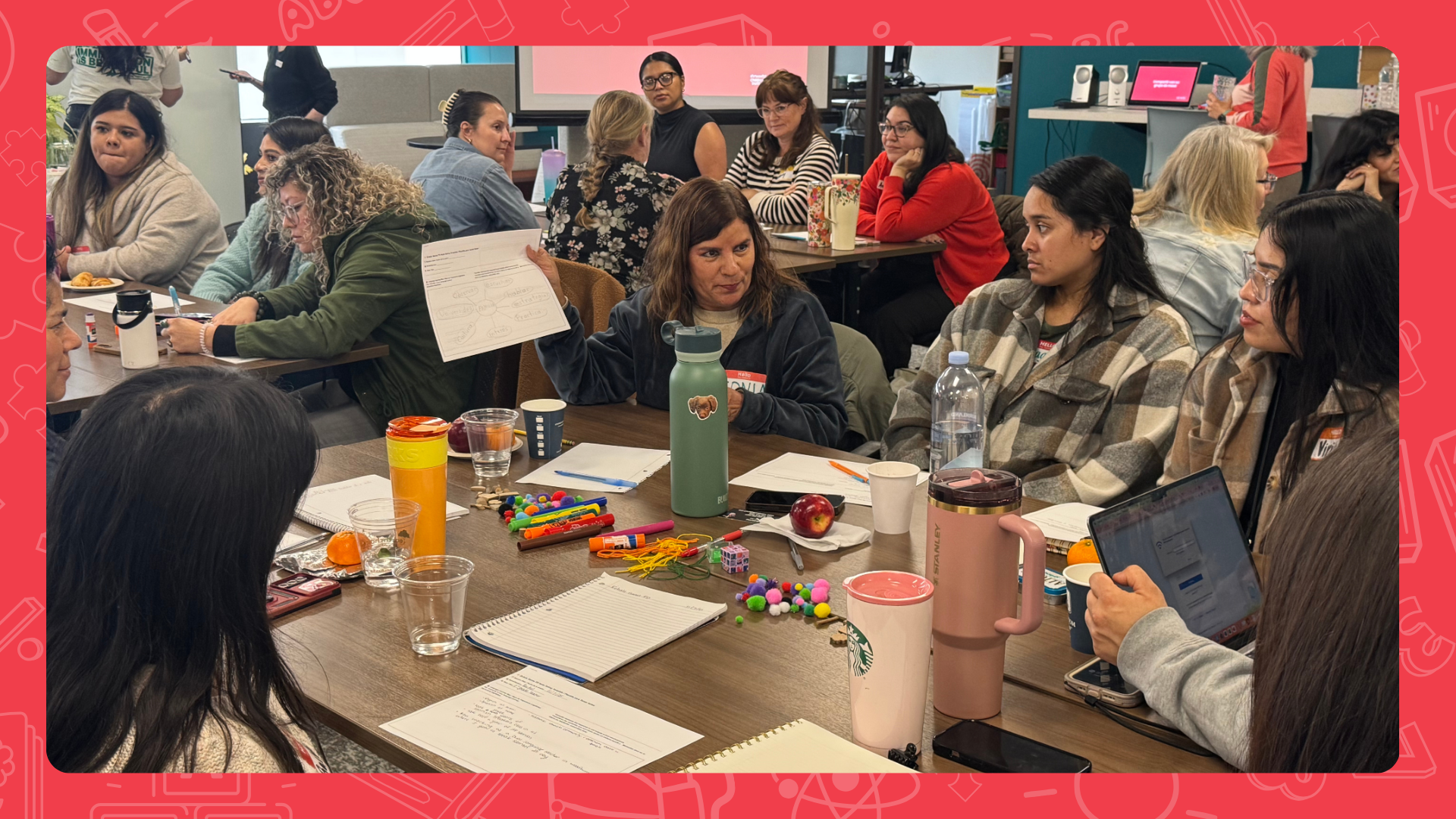


Building on this, Julio guided participants through multiple Language Lab stations to leverage their expertise while exploring design strategies that foster language-rich environments supportive of multilingual students. These focused on three core practices: translanguaging, biliteracy, and bilingual playful inquiry.
Some of the teachers shared that math-based games can teach turn-taking and sharing, reinforcing social skills alongside academic concepts. These inclusive, playful approaches foster safety, connection, and joy, ultimately creating classrooms where multilingual and bicultural students thrive.
The Practice: What teachers designed and created
Teachers were then invited to create a teaching practice model using loose parts that could support and deepen a multilingual learner’s experience. Even teachers new to CI’s ESS coaching model quickly began generating creative ideas together, using colorful, tactile materials to bring their concepts to life.
One team of teachers focused on syllables and phonetics using pipe cleaners, beads, LEGO-style blocks—turning literacy targets into a hands-on experience for both teachers and students. They explored how these simple materials, used intentionally, can help students identify sounds, syllables, and stress points in words like sapo or casa, while also strengthening fine motor skills. Another teacher expressed that she had to adapt to the limited time, preventing her from prepping materials, so she often resorted to just using hard materials like cut-up index cards. This practice neither engaged her nor her students, signaling that simply dreaming and waiting for more resources is not enough.
By the end of the six-hour session, the group envisioned and experienced a shift toward intentional, playful inquiry, where manipulatives, movement, and creativity are more than just distant dreams but essential strategies for engaging students to successfully learn. A kindergarten teacher encouraged her peer by saying, “If kindergartens can do this, first graders can too.” The spark of possibility carried through the room.
This energy was infectious, affirming that when we give our teachers the high-quality professional development to reflect, play, and experiment in ways they can intentionally support multilingual students in their classrooms, new ideas transform practice and lead to meaningful learning experiences.
The Takeaways: Insights, emotions, and reflections
To close the day, teachers stood together in a circle and reflected on what the experience meant. “(In my) 19th year (of teaching), I have never been in a space that looks like this, and that is something we need to be thankful for.” This session created a space where they could see themselves as part of a much bigger narrative than what happens within their individual school sites.
When we intentionally flip the script and center teachers’ lived experiences and wisdom, we collectively move forward. The session validated what we know to be true; teachers understand what they need in the classroom because they are closest to the work.
“The energy was inspiring. In just one day, the teachers uplifted the work in ways that I’ve never seen, sharing stories, sharing practices, and asking critical questions on the system, while providing answers on what the system can do to better serve the students and families. It was a beautiful space to say the least.”
What surprised us was the level of hunger for this kind of professional development. Even teachers who couldn’t attend were asked for materials and future opportunities. We saw that Oregon’s teachers want this, they need this, and those who joined us left energized to keep building an education system that meaningfully supports our multilingual learners.
The Bigger Picture: What Oregon needs next
Early in the day, teachers raised critical questions that only our system leaders can truly answer: “Why do so many multilingual learners appear concentrated in elementary grades? How do we identify and support students as they transition to higher grades? How is language development measured, and how do families understand those processes?”
These questions point to a larger issue: without clear systems and collaboration, multilingual students and their families face stigma, confusion, and unnecessary barriers. Teachers emphasized that advocacy is essential, not just for adopting language-specific programs within schools or districts, but for shifting mindsets to see bilingualism as a strength and investment in Oregon’s future.
How we invest in, create, implement, and experience professional development for teachers must fundamentally evolve. It should create a space for trust, reflection, vulnerability, curiosity, growth, and shared learning among teachers. Julio and the leaders who joined demonstrated that bilingual and multilingual teachers are leaders best positioned to create this change. Their voices, experiences, and cultural knowledge must be centered in curriculum, budgeting, academic standards, and professional learning.
Échale Ganas showed what’s possible when they are.
Interested in joining our next session? Reach out to Julio Bautista at julio@childinst.org